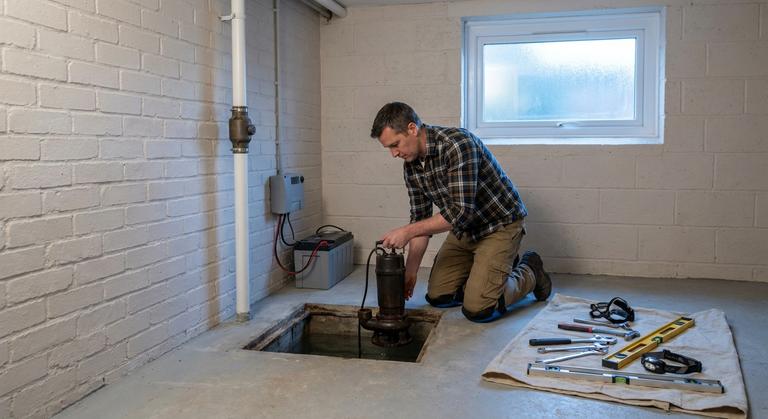
If you manage rental houses, duplexes or low-rise buildings anywhere in Canada, the sump pump is the least glamorous piece of equipment in the building and the one most likely to stand between you and a flooded-basement claim. It is also surprisingly hard to pin down sump pump installation cost Canada-wide, because no two quotes cover the same scope. One contractor is swapping a pump into an existing pit; another is cutting concrete, tying into the weeping tile and running a new discharge line to grade. This guide breaks the quote into its parts, explains when replacement beats repair, and compares the backup options that actually keep water out when the hydro fails during spring melt.
Why sump pumps earn their keep in Canadian basements
When frozen ground thaws from the top down in March and April, meltwater runs along the foundation, the weeping tile collects it, and the pump is the only thing lifting it away from the building.
For a property manager the stakes are different than for an owner-occupier. You are not there when the float sticks, and the tenant may not notice until the carpet squelches. Afterwards, the insurance conversation often turns on whether the equipment was maintained, since sewer backup and overland water coverage in Canada are typically optional endorsements with their own conditions.
Sump pump installation cost Canada: what is actually in the quote
We are deliberately not quoting dollar figures. Prices move with region, season and what the contractor finds once the lid comes off. Understanding the line items is what lets you compare quotes like for like.
1. The pump itself
- Pedestal pumps sit above the pit with the motor on a column. Cheaper, noisier, easier to service, lower capacity.
- Submersible pumps sit sealed inside the pit. Quieter, higher volume, longer expected life, higher unit cost.
- Horsepower and head height matter: a deep pit with a long vertical lift needs a stronger pump than a shallow one with a short run to grade.
- Cast iron housings generally outlast thermoplastic, and a vertical float switch sticks less often than a tethered one in a narrow pit.
2. The pit, liner and lid
If the property already has a properly sized pit with a solid liner, this line is close to zero. If the pit is undersized, cracked, or simply a hole in the slab, expect a new liner and a sealed lid, which also keeps radon and humidity out of the living space.
3. Discharge piping and check valve
A check valve stops pumped water draining back into the pit. The line must discharge well away from the foundation, not onto a neighbour's lot, and not across a walkway where it will ice over in February. Many municipalities prohibit connecting a sump discharge to the sanitary sewer, so correcting an older house plumbed that way may be in the quote.
4. Electrical
A sump pump belongs on its own dedicated circuit with a GFCI-protected receptacle near the pit, never on an extension cord. If no suitable circuit exists, a licensed electrician has to run one, and in many provinces that needs a permit and inspection through the provincial electrical safety authority.
5. Concrete cutting and weeping tile tie-in
This is where new installations diverge from replacements. Breaking the slab, digging the pit, connecting the weeping tile and re-pouring the concrete is usually the single largest labour item and may trigger a building permit depending on the municipality. Backup is usually quoted as a separate add-on; it is the line most PMs strike out to save money and most regret later.
Replacement versus new installation
Replacement is the simpler scope when the pit, discharge line and electrical are already sound. A like-for-like swap is typically a half-day job for one plumber. The sump pump installation cost in Canada climbs sharply when those supporting pieces have to be built from scratch, and a new install with slab cutting can run one to two days, longer if a permit inspection lands mid-job.
Signs it is time to replace rather than repair
- The pump is past the age the manufacturer suggests, or nobody knows how old it is.
- It short-cycles, switching on and off every few seconds, which usually points to a failing switch or an undersized pit.
- It runs but the water level barely drops. Impeller wear, a clogged intake or a failed check valve are the usual suspects.
- Visible rust, a cracked housing, a motor that hums without pumping, or a history of running dry.
If a tenant reports any of these, treat it as urgent. A pump that is struggling in August will not survive April.
Backup options: which one fits a property you do not live in
Power outages cluster around exactly the weather that fills a sump pit: ice storms, spring thunderstorms and heavy wet snow. Backup is the part of sump pump installation cost in Canada that pays for itself in a single outage.
Battery backup pump
A second, smaller pump in the same pit, wired to a deep-cycle battery and charger. Runtime depends on battery size and how often the pit fills, and batteries age out every few years. This is the most common choice for rentals because it works anywhere there is a pit.
Water-powered backup pump
Uses municipal water pressure to create suction and eject pit water, so it needs no electricity and no battery. It only works on municipal supply with adequate pressure, never on a well, and some municipalities restrict it because it consumes treated drinking water and needs backflow protection. Confirm it is permitted locally.
Generator, alarm and remote monitoring
A standby generator makes sense for larger buildings where it already covers heating controls and emergency lighting. For a single rental house, the better-value add-on is a Wi-Fi float alarm that texts you when the water rises. It turns "the tenant noticed on Sunday" into "I got an alert at 3 a.m. and had someone there by 7."
Rebates, code and the questions to ask before you sign
Several Canadian municipalities run basement flooding protection programs that partially reimburse owners for backwater valves, sump pumps and related work. Eligibility, caps and inspection steps vary by city and change from year to year, so check the municipal website for each property. Where a program exists, it usually requires a permit and an itemized invoice, so tell the contractor up front that you intend to apply. A rebate can take a real bite out of sump pump installation cost in Canada where one applies.
On the code side: discharge to grade or storm where required, never to sanitary; electrical by a licensed electrician with the appropriate permit; and a building permit when the slab is cut or the weeping tile altered. A contractor who shrugs at any of these is telling you something.
How to get a fair quote as a property manager
- Photograph the pit with the lid off, the discharge line, the nearest receptacle and the exterior discharge point, and send them with the job request.
- Ask every bidder for the same scope: pump type and horsepower, liner and lid, check valve, discharge route, electrical, permit handling, and backup as a separate line.
- Get the warranty in writing, separating the manufacturer's pump warranty from the contractor's workmanship warranty.
- Schedule outside peak season. Plumbers are slammed in April when every basement in town is wet. Late summer and fall are the quiet window.
Platforms like PlanaJob let property managers post one job and compare quotes from vetted contractors side by side. See how it works at PlanaJob for property managers. If you are curious why two contractors price the same scope so differently, Construction Arbitrage writes about how trade firms set rates and manage seasonal demand. There is more Canadian maintenance guidance on the PlanaJob blog.
Put it on the maintenance calendar
Keeping the pump running costs very little, but it has to actually happen:
- Twice a year, pour a bucket of water into the pit and confirm the float rises, the pump runs, and the level drops quickly.
- Listen for the check valve closing. If water gurgles back, replace it.
- In winter, check the exterior discharge has not frozen solid. A frozen line deadheads the pump and burns out the motor.
- Check the backup battery's charge and age, and test the alarm.
Do this in October and again in late February, and you will catch most failures before the melt does. If the February check turns up a tired pump, do not wait. Book a sump pump pro on PlanaJob before spring melt tests your basement.
FAQ
What affects sump pump installation cost in Canada the most?
Whether the pit, discharge line and electrical already exist. A straight replacement into a sound pit is a modest plumbing job. Cutting the slab, building a new pit and running a new circuit turns it into a multi-trade project.
Does a rental property in Canada legally need a sump pump?
Requirements come from provincial building codes and municipal bylaws, and they apply mainly to new construction and certain renovations. In practice, your insurance wording and your duty to keep the unit habitable under provincial tenancy legislation both point the same way: keep the basement dry.
Which backup is best if the property is on a well?
A water-powered backup will not work without municipal water pressure, so a battery backup pump paired with a remote high-water alarm is the practical choice. If the property already has a standby generator for the well pump, put the sump circuit on the generator panel too.