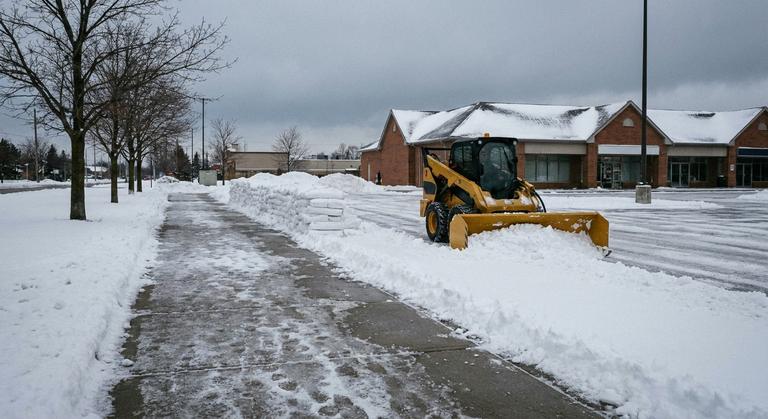
Ask three contractors to price winter service on the same strip plaza and you get three numbers that look nothing alike. That is usually not gouging. Any snow removal cost Canada figure is close to meaningless until you attach the contract structure to it: one quote is a flat seasonal fee that hands weather risk to the contractor, one is a per-visit rate that leaves that risk with you, and one is hourly plus salt at cost, which is a rate card pretending to be a quote. Here is how each model is built, what pushes the price up on your site, and how to run the break-even before you sign.
What drives snow removal cost Canada-wide
Snow pricing is built from four inputs: time on site, equipment class, materials and risk. Two properties with identical square footage can land far apart on all four.
Site geometry beats square footage
A long, open lot lets a loader with a pusher box move volume in a few passes. A tight lot with islands, bollards, cart corrals and cars that never move needs a skid steer doing dozens of short passes plus hand work. The second site takes far longer per square metre and prices accordingly.
Then there is the question nobody asks until February: where does the snow go? Stacking on site is cheap. Once the piles block sightlines, swallow stalls or creep into fire routes, you are into relocation or trucking off site, a separate mobilization with loaders and tandem trucks that is almost always billed outside the base contract.
Ice management is the line item that moves the budget
In southern Ontario, the Maritimes and the Lower Mainland, freeze-thaw cycles can generate more billable events than snowfall does. Salt is a volatile-priced consumable, and bulk versus bagged, treated versus straight sodium chloride, and brine applied before a storm all price differently.
Ask every bidder: is salt included, capped at a set number of applications, or billed per application? That clause moves more money over a winter than the plow rate does.
The service standard you are buying
Zero-tolerance sites such as clinics, seniors housing and grocery-anchored retail get monitored, pre-treated and cleared during the storm. An industrial yard on daytime hours can be cleared once after the snow stops. Sidewalks, stairs and entrances need a separate crew and cost far more per metre than open lot does.
Municipal bylaws set a clearing window after snowfall ends, and they differ city to city. Your contract's response time should be tighter than the bylaw, not equal to it.
Seasonal contracts: paying for certainty
A seasonal contract is a fixed fee for a defined term, commonly November through mid-April, covering an agreed scope of plowing, sidewalks and salting, usually billed in equal monthly instalments. You are buying two things: a budget number you can set in September, and a place in the route order.
Seasonal tends to win when:
- The site is zero-tolerance and you cannot risk being third in the queue.
- You are in a high-event region such as the Ontario snowbelt, Quebec or Atlantic Canada, where a heavy winter would blow a per-visit budget apart.
- You manage a portfolio and need one predictable line per property, not a stack of variable invoices.
- Your owner or board treats an overrun as worse than paying a premium.
Exclusions are the biggest hidden swing in snow removal cost Canada budgets. Read for an excess-event clause that bills extra above a set accumulation, a salt cap, sidewalks quoted separately and hauling excluded by default. If the word "unlimited" appears, make the contractor write the definition beside it.
Contractors price seasonal work off historical event counts plus a margin for a bad winter. In a light season they win, in a brutal one they absorb it. If you want to see how the other side models that, the writing at Construction Arbitrage is a useful look at how trade businesses price volatility into fixed-fee work.
Per-visit pricing: paying for what actually falls
Per-visit shifts the weather risk back to you and pays off in a mild winter.
Per push and trigger depths
The contract names a trigger depth, usually between roughly 2 cm for zero-tolerance retail and 5 cm for industrial or residential sites. Below it, nothing happens and nothing is billed. The clause that catches people is the re-push rule: in a 30 cm storm, does the crew come once at the end, or every time accumulation hits the trigger again? Both are legitimate, and they produce very different invoices for the same storm.
Tiered depth bands and time-and-materials
Many Canadian contractors quote bands: one rate for 0 to 5 cm, a higher one for 5 to 10 cm, and so on. That is fairer on both sides but harder to compare, because you have to weight each band by how often it occurs at your site. Hourly rates plus salt by the tonne are the most transparent structure and the hardest to control, so keep time and materials for unpredictable scope such as a one-off haul-away, and insist on time-stamped logs and scale tickets.
Run the break-even before you choose
Do not argue about which model is cheaper in the abstract. Calculate it.
- Ask the same contractor to price both structures on one written scope. Bidders scoping differently is the number one reason snow removal cost Canada comparisons look inconsistent.
- Divide the seasonal fee by the per-visit rate. That is your break-even visit count.
- Pull about ten years of daily snowfall for the nearest Environment and Climate Change Canada station and count days above your trigger depth, adding re-pushes for multi-day storms.
- Compare the two numbers. If they land within roughly 15 percent, price is not the deciding factor. Decide on cash flow and risk appetite instead.
- Price the tail. What would the worst winter in that record have cost per visit? That is what the seasonal fee insures against, and the figure to show an owner who thinks seasonal looks expensive.
What every quote must itemize
Most snow removal cost Canada comparisons fall apart on scope, not price. Two bids are comparable only when both state:
- Trigger depth and who measures it, including the reference station or on-site gauge
- Response time measured from the trigger, not from when the storm ends
- Re-push rules for storms above a stated accumulation
- Salt: included, capped or extra, plus product type and whether anti-icing is in scope
- Sidewalks, entrances, stairs and accessible parking, in or out
- Snow relocation and hauling trigger, rate and lead time
- A site map marking stacking zones, no-plow areas, catch basins, EV chargers and fire routes
- Term dates and what happens in a season with almost no snow
- Insurance limits, additional insured status and current provincial workers' compensation clearance
- Documentation: time-stamped logs, photo or GPS evidence and salt quantities per visit
Vetting, insurance and the paper trail
Slip-and-fall exposure is why these contracts read the way they do. Get the commercial general liability certificate naming you as additional insured, confirm the provincial workers' compensation clearance is current, and require that subcontractors are disclosed with the same coverage.
Ontario, for example, requires written notice of a snow or ice injury claim to the occupier and the contractor within a short statutory window. Confirm the current requirement with your insurer or counsel, and make sure your contractor's records can survive a claim filed months later. Your defence is the service log, not someone's memory of the night.
One more check: confirm who owns the company. Snow and landscape businesses change hands often, which is why marketplaces like Contractor Exit exist, and a great crew under new ownership is worth verifying before you commit for a season.
Get comparable quotes before November
Contractors build routes in September and October. By the time the first flurries land, the good ones are full and you are negotiating from weakness. Send one written scope to three bidders in late summer and give each a site walk, not a satellite image. Platforms like PlanaJob let property managers compare quotes from vetted contractors on identical scope, which removes most of the apples-to-oranges problem behind confusing snow removal cost Canada comparisons. Standardize that scope document once and reuse it across the portfolio. You can see how the marketplace works for multi-site work on the PlanaJob property manager page, and there are more Canadian cost guides on the PlanaJob blog.
Lock in a vetted seasonal snow contract before November demand spikes: post your site scope on PlanaJob and collect comparable quotes while contractors still have route capacity.
FAQ
Is a seasonal contract cheaper than per-visit pricing in Canada?
Over one mild winter, per-visit almost always costs less. Across three to five winters the two converge, because the seasonal premium is essentially an insurance charge for the heavy years. Judge snow removal cost Canada quotes against ten years of local snowfall data, not last winter, which may have been an outlier.
What trigger depth should I set for my property?
Match it to the risk, not the budget. Clinics, seniors residences and grocery-anchored retail are usually written at the lowest practical trigger with anti-icing before the storm, while industrial and low-traffic sites can sit higher. Whatever you choose, make sure the contract also covers ice events with no measurable snowfall.
When should I sign a snow contract for the coming winter?
Late summer to early autumn. Route capacity is allocated before the season starts and pricing firms up as November approaches. Signing early also leaves time for a site walk, a snow-stacking plan and insurance verification, rather than a rushed decision during the first storm.