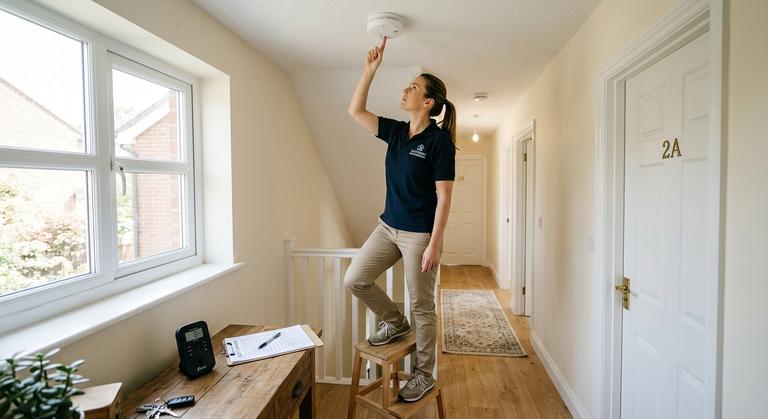
Ask any Ontario fire service what the fatal fires have in common and the answer is depressingly consistent: alarms that were missing, expired, or disconnected. For landlords and property managers, the smoke alarm requirements for Ontario rental properties are among the clearest legal duties you carry. The Ontario Fire Code spells out where alarms must be installed, who maintains them, and what happens when the rules are ignored - and since 2014, carbon monoxide alarms carry their own parallel set of obligations. This guide covers both, the penalties for getting it wrong, and a practical way to keep an entire portfolio compliant without it swallowing your calendar.
Smoke Alarm Requirements for Ontario Rental Properties
The rules come from the Ontario Fire Code, a regulation made under the Fire Protection and Prevention Act, 1997. For residential occupancies, working smoke alarms are required:
- On every storey of the dwelling, including basements, whether or not anyone sleeps there
- Outside all sleeping areas, close enough that an alarm will wake someone behind a closed bedroom door
In a rental, responsibility sits squarely with the landlord. It is not something you can transfer to the tenant in a lease clause, and "the tenant took the battery out" is not a defence if you never checked. The core landlord duties are:
- Install alarms in the required locations, following the manufacturer's instructions - hardwired, battery, or wireless-interconnected units all count if they meet the applicable standard and are working.
- Test alarms after every change in tenancy, after a battery is replaced, after any changes to the electrical circuit that could affect a hardwired unit, and at least annually.
- Maintain and replace alarms in line with the manufacturer's instructions, including swapping units that have passed their stated end-of-life date - commonly around ten years for smoke alarms.
- Inform tenants by providing the alarm maintenance instructions, so occupants know how the unit works and what the low-battery chirp means.
Tenants have duties too. They must notify the landlord promptly if an alarm is not operating, and it is an offence for anyone - tenant or landlord - to disable an alarm, remove its battery, or otherwise render it inoperative. Documenting that you told tenants this at move-in is one of the cheapest pieces of protection you can buy.
Carbon Monoxide Alarm Rules: The Other Half of the Job
Carbon monoxide alarms became mandatory in existing Ontario homes following the Hawkins-Gignac Act, with the updated Fire Code requirements phasing in from 2014. A CO alarm is required in a rental unit if the home contains a fuel-burning appliance - a gas furnace, gas water heater, fireplace, or wood stove, for example - or has an attached garage.
Placement differs from smoke alarms: CO alarms go adjacent to each sleeping area, so the priority is the hallway outside bedrooms rather than every storey. In multi-unit residential buildings, alarms are also required in service rooms containing fuel-burning appliances and in suites adjacent to those service rooms or to a garage.
Two practical notes for property managers:
- An all-electric unit with no fuel-burning appliances and no attached garage may fall outside the CO requirement, but many landlords install combination smoke and CO units anyway. The hardware cost is trivial next to the risk, and it simplifies your inspection checklist to one standard across the portfolio.
- CO alarms expire faster than most people assume. Check the date printed on the unit during every inspection, not just whether it beeps.
Landlord Duties in Practice: Testing, Records, and Entry
Knowing the smoke alarm requirements for an Ontario rental is the easy part. Proving you met them, months or years later, is where landlords get caught out.
Keep a written log for every unit
A fire inspector or a Landlord and Tenant Board adjudicator will want evidence, not memories. For each visit, record the unit address, the date, each alarm tested and its location, the result, who carried out the test, and any batteries or units replaced. Have the tenant sign an acknowledgment at move-in confirming the alarms were demonstrated as working and that they received the maintenance instructions. Paper works, but a shared digital log scales better once you pass a handful of doors.
Give proper notice for entry
Alarm testing inside an occupied unit is still entry. Under Ontario's Residential Tenancies Act, that means written notice at least 24 hours in advance, stating the reason and a time window between 8 a.m. and 8 p.m. Build this into your inspection workflow so a compliance task never turns into an illegal-entry complaint.
Respond fast to tenant reports
If a tenant tells you an alarm is chirping or dead, treat it with the urgency of a no-heat call in January. The Fire Code obligation is continuous - an alarm that failed three weeks ago and was never fixed is a live offence, not a historical one.
Fines for Non-Compliance in Ontario
Ontario fire services actively enforce alarm provisions, and the consequences scale with the severity of the failure. Municipal fire departments can issue provincial offence tickets for straightforward violations, and for more serious matters can prosecute under the Fire Protection and Prevention Act, 1997. On conviction, individuals face fines of up to $50,000 and possible imprisonment, while corporations face fines of up to $100,000 per offence. Where a violation contributes to injury or death, prosecutions and penalties at the top of that range are a realistic outcome, not a theoretical one.
The indirect costs bite too. A fire loss where alarms were non-compliant invites hard questions from your insurer, and tenants can pursue maintenance-related remedies through the Landlord and Tenant Board. Set against a few dollars of hardware and one scheduled visit per unit per year, ignoring smoke alarm requirements in an Ontario rental is one of the worst trades in property management.
Running Alarm Compliance Across a Portfolio
One unit is easy. Forty units across three municipalities, with staggered move-in dates, is where compliance quietly slips. A system that works looks like this:
- Pick one fixed annual inspection month for the whole portfolio, then layer change-of-tenancy tests on top as they happen.
- Standardize the hardware so every unit uses the same alarm models, making expiry tracking and battery stock simple.
- Use one checklist per unit covering smoke alarms, CO alarms, expiry dates, and tenant sign-off, filed centrally.
- Book the work as a single batch rather than unit by unit.
That last point is where most managers lose time. Platforms like PlanaJob let you compare quotes from vetted contractors instead of ringing around, and you can schedule annual alarm inspections across your whole portfolio in one PlanaJob booking - one job posting, one contractor, one paper trail. If that sounds like your bottleneck, see how it works for property managers at planajob.com/ca/property-managers or create a free account at planajob.com/signup.
For contractors reading this: alarm inspections are exactly the kind of recurring, low-overhead compliance work that smooths out seasonal swings. There is solid thinking on building recurring revenue lines like this at constructionarbitrage.com, and if you ever sell your business, a book of annual inspection contracts is precisely what buyers on contractorexit.com pay a premium for.
For more compliance guides for Canadian landlords, browse the PlanaJob blog.
FAQ
Who is responsible for smoke alarms in an Ontario rental - the landlord or the tenant?
The landlord. Ontario's Fire Code places the duty to install, test, and maintain smoke alarms on the property owner, and that duty cannot be signed away in a lease. Tenants must report non-working alarms and must never disable them, but the compliance burden - and the fine if an inspector finds a dead alarm - lands on the landlord.
Do I need a carbon monoxide alarm in every rental unit?
A CO alarm is required if the unit has a fuel-burning appliance, such as a gas furnace, water heater, or fireplace, or an attached garage, with the alarm installed adjacent to the sleeping areas. Multi-unit buildings have additional requirements around service rooms and adjacent suites. Even where a unit technically falls outside the rule, installing combination units portfolio-wide is cheap and simplifies inspections.
How often do smoke alarms need to be tested and replaced in Ontario rentals?
Test at least annually, after every change in tenancy, after replacing a battery, and after any electrical work that could affect a hardwired unit. Replace the alarm itself by the manufacturer's end-of-life date, typically around ten years for smoke alarms and often sooner for CO alarms - check the date stamped on each unit during your annual round.