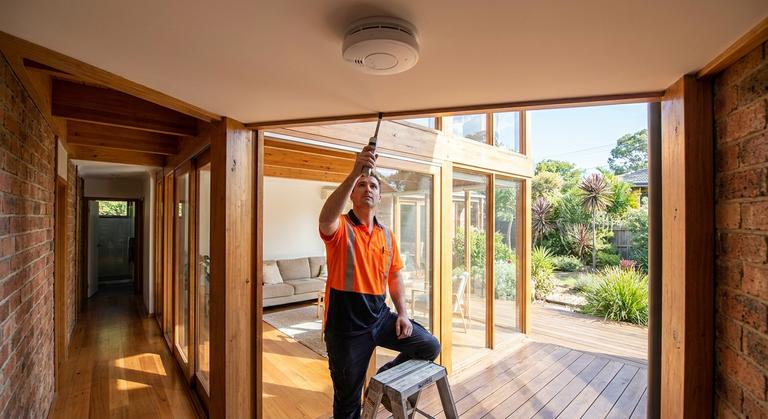
Smoke alarm compliance NSW rental duties catch out more agencies than any other maintenance item, not because the rules are complicated but because they are small, frequent and clock-driven. A chirping alarm reported on a Friday afternoon can put a landlord outside the law by Tuesday. NSW does not expect you to be a fire engineer. It does expect you to show that every alarm in every tenancy was checked, working and dated. Here is what applies in 2026, how to build a routine around it, and where property managers most often slip.
The smoke alarm compliance NSW rental rules, in plain English
Working smoke alarms have been mandatory in every NSW home since May 2006. What changed for the rental sector was the Residential Tenancies Amendment (Smoke Alarms) Regulation 2020, in force since 23 March 2020, which spelled out who does what.
As the landlord, or the agent acting for them, you must:
- Make sure smoke alarms are installed and in working order in the premises.
- Check every alarm at least once each 12 months.
- Replace removable batteries annually, and for sealed 10-year lithium units, replace the alarm or battery when it fails or signals that it is flat.
- Replace any alarm more than 10 years old, measured from the manufacture date printed on the unit, or sooner if the manufacturer specifies a shorter life.
- Repair or replace an alarm that is not working within 2 business days of becoming aware of it.
- Never remove an alarm, disconnect it, or do anything that reduces how well it works.
Tenants carry obligations as well. They must tell you as soon as practicable if an alarm stops working, they must not remove or interfere with it, and they may change a removable battery themselves if they can do so safely. If the alarm is hardwired, out of reach, or the tenant cannot manage it, the job comes back to you.
The two business day clock is where landlords slip
The 2 business day window starts when you become aware, not when it suits your maintenance run. A Friday report means Tuesday. If you have not repaired or replaced the alarm in that time, the tenant is entitled to arrange the work themselves and ask you in writing to reimburse what they spent, and you have 7 days to pay it.
The practical fix is triage at the point of contact. Whoever answers the phone or the maintenance inbox should be able to flag a smoke alarm report instantly, because smoke alarm compliance for NSW rental properties fixes the response time in regulation rather than leaving it to your usual repair queue.
Strata, granny flats and second dwellings
Inside the lot, the alarms are the landlord's responsibility. Alarms in common property such as corridors, stairwells and lift lobbies sit with the owners corporation. If you manage apartments, do not assume the building's annual fire safety work covers the alarms inside your lot, because it usually does not. Secondary dwellings and granny flats count as separate residences, each needing their own compliant alarms, annual check and record.
Placement and alarm type: what counts as compliant
Smoke alarm compliance NSW rental properties starts with the hardware. Alarms must comply with Australian Standard AS 3786. Placement follows the National Construction Code: at least one alarm on every storey, in hallways serving bedrooms, or between the bedrooms and the rest of the home where there is no hallway, and on storeys without bedrooms in the path of travel people would use to leave.
The age of the building governs power supply. Homes built or substantially renovated after the 2006 change generally require mains-powered alarms with a backup battery, installed by a licensed electrician. Older homes may still run battery-only alarms, provided they work and meet the standard.
Alarm type is where the legal minimum and best practice part company. Fire and Rescue NSW recommends photoelectric alarms, which respond faster to the smouldering fires that kill people in their sleep. NSW has not followed Queensland, where rental properties have needed interconnected photoelectric alarms in every bedroom, in connecting hallways and on each storey since 1 January 2022. If you manage across state lines, do not assume one specification satisfies both. Upgrading a NSW rental to sealed 10-year photoelectric units is not mandatory, but it removes the annual battery task and is cheap to do at changeover.
A 12 month routine that holds up under scrutiny
Smoke alarm compliance NSW rental work fails on memory and survives on calendars. Build the routine once and let it repeat.
- Load a check date for every property into your system the day the tenancy starts, then repeat it annually rather than tracking it per tenancy.
- Batch by suburb so one technician covers a run of properties in a day instead of one address at a time.
- Give the right entry notice. For installing, repairing or replacing an alarm you need at least 1 hour's notice. Folding the check into a routine inspection means 7 days' notice, and you are limited to four inspections in any 12 months.
- Test with the button, confirm the sounder, and photograph the manufacture date stamped on the unit.
- Replace removable batteries at the same visit rather than booking a second attendance.
- Flag any unit within 12 months of its 10-year expiry so replacement is planned, not reactive.
- File the report against the property, not the tenancy, so the history survives tenant turnover.
Records that prove smoke alarm compliance NSW rental obligations were met
If a claim or a Fair Trading complaint ever lands, the question is not whether you believed the alarms worked. It is what you can produce. Keep a dated technician report per property listing each alarm by location, its manufacture date and the test result, plus photographs, the smoke alarm section of the ingoing condition report completed with the tenant, and a timestamped log of any tenant report alongside your response so the 2 business day window is evidenced. Confirm in writing to the tenant what you did and when, so the paper trail sits in one place.
Getting the work done across a portfolio
The bottleneck is rarely knowledge, it is booking. Battery-only checks can be done by a competent person, but any work on 240V hardwired alarms in NSW must be carried out by a licensed electrician. Ask for the licence number, agree the report format before the first job, and price a run of properties rather than each address separately.
Platforms like PlanaJob let property managers compare quotes from vetted contractors side by side, so you can line up an annual round without ringing five electricians. The tooling we build for portfolio compliance lives at https://planajob.com/au/property-managers, and there are more compliance walkthroughs at https://planajob.com/au/blog.
Contractors reading this: annual compliance rounds are some of the most valuable work you can hold because they are predictable and they renew, a point covered well at https://constructionarbitrage.com, and it is why testing businesses with contracted rounds change hands more easily than purely reactive ones, as the material at https://contractorexit.com shows.
Book a licensed smoke alarm technician through PlanaJob in minutes. Post the address, the alarm count and the due date, then compare quotes from vetted local trades. You can set that up at https://planajob.com/signup before your next annual round falls due.
FAQ
Do NSW rentals need interconnected photoelectric smoke alarms?
No. As at 2026, NSW requires alarms that comply with AS 3786 and meet the placement rules in the National Construction Code, and it has not adopted Queensland's interconnected photoelectric requirement for rentals. Fire and Rescue NSW still recommends photoelectric alarms, and interconnection is worth doing voluntarily when a property is vacant.
Can my tenant replace the smoke alarm battery themselves?
Yes, where the battery is removable and the tenant can reach it safely. Ask them to tell you they have done it so your records stay accurate. If they cannot, or the alarm is hardwired, they must notify you and you have 2 business days to act. Miss that window and the tenant can arrange the work and request reimbursement in writing, which you must pay within 7 days.
How often do smoke alarms need to be checked and replaced?
The law requires a check at least once every 12 months, with removable batteries replaced annually. Every alarm must be replaced within 10 years of its manufacture date, or sooner if the manufacturer specifies a shorter life. Encourage tenants to press the test button monthly between your annual visits, and treat any chirp as a same-week job.