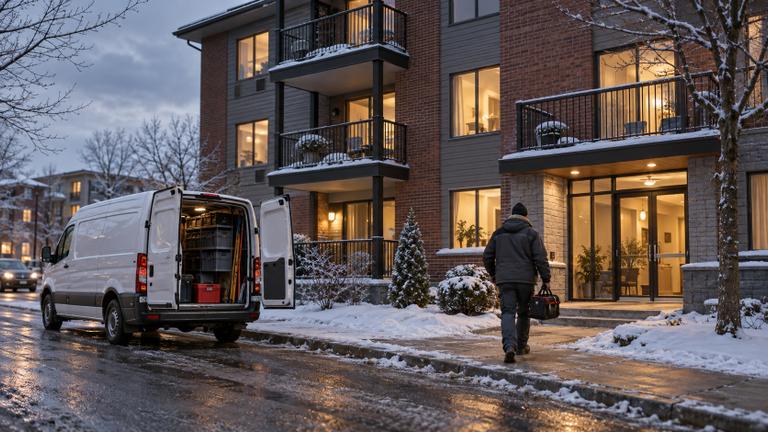
A tenant texts at 9:40 on a February night: the furnace has quit, it is minus nineteen outside, and there is a toddler in the unit. Between that message and a technician on site sits a question every property manager eventually answers with evidence rather than instinct. The honest answer on landlord repair response time Canada-wide is that no statute in the country gives you a single number. Residential tenancy law is provincial and territorial, the operative test is almost always a reasonable time, and the hard deadlines that do exist come from a municipal bylaw, a public health order, or the standard you set for yourself.
Why There Is No Single Landlord Repair Response Time in Canada
Every province and territory writes the same core duty in slightly different words: keep the unit in a good state of repair, fit for habitation, and compliant with health, safety and housing standards. Almost none attach hours to it. That is deliberate. A blocked kitchen drain and a dead furnace in Winnipeg in January are not the same emergency, and legislators left adjudicators room to say so.
Your landlord repair response time is therefore judged after the fact, against severity. Tribunals across the country ask the same questions:
- How serious was the risk to health, safety or the building itself?
- When did you know, or when should you reasonably have known?
- Did you acknowledge the request in writing, with a named owner and an expected date?
- Did you offer interim mitigation - portable heat, a hotel night, bottled water, a temporary lock?
- If parts, permits or trade availability caused the delay, can you prove it?
An eight-day wait for a dishwasher part with the purchase order attached is defensible. Eight days of silence is not.
Where the Real Deadlines Live, Province by Province
There is no national landlord repair response time in Canada, so the answer changes at every provincial border. Here is what each jurisdiction actually gives you.
British Columbia
BC is the most specific jurisdiction in the country. The Residential Tenancy Act defines emergency repairs as work that is urgent, necessary for health and safety or to preserve the property, and falls within named categories: major leaks in pipes or the roof, damaged or blocked water or sewer pipes or plumbing fixtures, the primary heating system, damaged or defective locks giving access to the unit, and the electrical systems. Landlords must provide a name and telephone number for emergencies. A tenant who makes at least two attempts to reach that contact and then allows reasonable time may arrange the repair and deduct the cost from rent. Your real deadline in BC is how long that phone goes unanswered.
Alberta
Alberta layers the Residential Tenancies Act over the Minimum Housing and Health Standards made under public health legislation. The tenancy statute sets the duty; the teeth come from an environmental public health inspector, whose order names an actual compliance date. Once an order exists, that date is your timeline.
Saskatchewan and Manitoba
Saskatchewan's Office of Residential Tenancies and Manitoba's Residential Tenancies Branch take maintenance complaints directly, can inspect, and can order repairs completed by a stated date alongside a rent reduction for the period the unit was substandard. In both provinces, treat any loss of heat between October and April as same-day work.
Ontario
The Residential Tenancies Act, 2006 places repair and maintenance on the landlord regardless of whether the tenant knew about the defect before moving in. Ontario also protects vital services - hot or cold water, fuel, electricity, gas, and heat during the prescribed heating season - which a landlord may not withhold or deliberately interfere with. Where the landlord supplies heat, the regulations require a minimum of 20 degrees Celsius from September 1 to June 15, and several municipalities, Toronto among them, set a stricter standard by bylaw. Property standards officers issue orders with compliance dates, and tenants can apply to the Landlord and Tenant Board for an abatement backdated to when you first knew.
Quebec
Quebec runs on the Civil Code rather than a standalone tenancy act, with disputes heard by the Tribunal administratif du logement. The landlord must deliver the dwelling in good habitable condition and keep it that way; the tenant must report defects. If the landlord does not act within a reasonable time after notice, the tenant may carry out necessary repairs and deduct the reasonable, documented cost from rent, and in genuine urgency may act first and notify immediately afterward.
Atlantic Canada
Nova Scotia's statutory conditions are blunt and cannot be contracted out of: the landlord keeps the premises in a good state of repair and fit for habitation even where the disrepair existed and was known before the lease was signed. New Brunswick's Residential Tenancies Tribunal can send an officer to inspect and order the work. Prince Edward Island and Newfoundland and Labrador follow the same pattern - complaint, inspection, order with a date, possible rent reduction.
The Territories
Yukon, the Northwest Territories and Nunavut impose comparable duties through their own legislation and rental officers. The practical difference is supply chain. If a part has to fly in, record the order date, the carrier and the expected arrival, because a rental officer will accept a documented logistics delay far more readily than a vague one.
A Triage Grid You Can Actually Defend
Since the statute will not give you a number, set one yourself. This is an operating standard, not a legal requirement, and publishing it works in your favour because it demonstrates a system rather than a scramble. It cannot be used to contract below your statutory duty, only to hold yourself above it.
- Life safety and habitability failures - no heat in the heating season, no water, no power, gas odour, sewage backup, exposed wiring, a failed exterior lock, or a smoke or carbon monoxide alarm fault. Acknowledge within one hour, attend the same day, keep a 24/7 line.
- Serious but not dangerous - the only toilet blocked, no hot water, a contained but persistent leak, a dead fridge. Acknowledge the same business day, attend within 24 to 48 hours.
- Routine - a failing appliance, a dripping tap, a sticking window, minor drywall damage. Acknowledge within one business day, complete within seven.
- Deferred and cosmetic - touch-up paint, worn flooring, cabinet hardware. Acknowledge within two business days, batch into a scheduled visit within 30 days.
The Paper Trail That Wins the Hearing
Hitting a fast landlord repair response time is worth nothing if you cannot prove it.
- Run one channel of record. Texts to a superintendent's personal phone are the most common reason a manager cannot prove when the clock started.
- Acknowledge every request in writing with a named owner and a date, even when the answer is that a part is on order.
- Respect entry rules. Most Canadian jurisdictions require at least 24 hours' written notice for non-emergency entry, with emergencies exempt. A refused entry you logged is a defence; one you did not log never happened.
- Keep invoices, back-order confirmations and trade call logs attached to the job, not buried in an inbox.
- Record interim mitigation. Space heaters delivered at 10 p.m. change the tone of a hearing.
Closing the Gap Between Decision and Dispatch
For most managers the problem is not the decision, it is the forty minutes spent phoning trades who do not answer. After-hours work is priced differently for a reason, and the economics of call-out rates and crew utilisation are covered well at Construction Arbitrage - a contractor who takes your midnight call is charging for readiness as much as labour. It is also worth keeping two qualified options per trade, since small trade firms change hands more often than most portfolios plan for, as anyone watching listings on Contractor Exit will notice.
Platforms like PlanaJob let property managers post a job once and compare quotes from vetted, insured contractors rather than working a phone list. PlanaJob's dispatch is built to turn a tenant request into a booked contractor within hours, with timestamps and quote history attached to the job automatically. You can create an account in a few minutes, see how the workflow fits a portfolio on the property managers page, or browse more operations guides on the PlanaJob blog.
FAQ
Is there a legal 24-hour repair deadline for landlords in Canada?
No. No province or territory sets a blanket 24-hour rule in its tenancy statute. The expected landlord repair response time in Canada is whatever is reasonable for the severity of the defect, and 24 hours is simply what reasonable tends to mean for heat, water or safety failures. Fixed deadlines appear in municipal property standards orders and public health orders, which name a specific compliance date.
Can a tenant withhold rent if I do not respond in time?
Usually not. Withholding rent is not a general self-help remedy in Canada and can expose a tenant to a non-payment eviction. The exceptions are narrow and structured: British Columbia's emergency repair provisions and Quebec's urgent repair rules both allow a tenant to arrange work and deduct a documented, reasonable cost after proper notice. Elsewhere, the tenant's route is an application to the tribunal for a repair order or rent abatement.
What counts as an emergency repair?
Anything that makes a unit unsafe or uninhabitable, or that worsens if left alone: loss of heat in winter, no water or sewage service, a suspected gas leak, electrical faults, a major leak, or a broken exterior lock. British Columbia lists these categories in statute; elsewhere they are the accepted working definition, and same-day attendance is the safest reading of your landlord repair response time obligations.