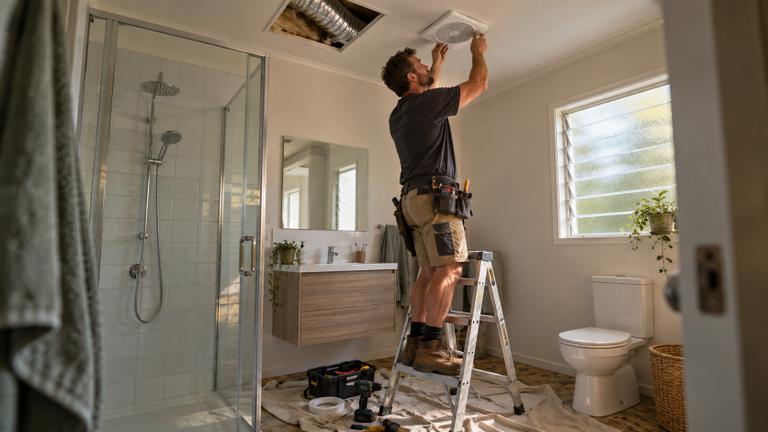
If you manage rentals in New Zealand, the healthy homes ventilation standard extractor fans rules are the ones most likely to catch you out at a final inspection. Heating and insulation get the attention because they cost the most, but ventilation is where the quiet failures sit: a bathroom fan that dumps steam into the ceiling cavity, a recirculating rangehood with a charcoal filter, a small fan that was acceptable in 2015 and is not acceptable now. Every private rental has had to meet the healthy homes standards since 1 July 2025, so 'we'll sort it at the next tenancy' is not a plan anymore. Here is what the standard actually requires, room by room, and how to get the work done across a portfolio without a month of coordination.
Why ventilation fails quietly
A heat pump either exists or it doesn't. A fan is either loud or silent, and most tenants assume loud means working. What nobody sees is where the air ends up. A bathroom fan ducted into the roof space still pulls steam out of the bathroom - it just parks it above the ceiling, where it condenses on the underside of the roof, soaks the insulation, and turns up months later as a stained ceiling and mould in the next bedroom along. One disconnected length of flexible duct gives you a ventilation breach, a moisture problem and an insulation bill at the same time. Fans are also cheap enough to get replaced by whoever is handy, and nobody checks the spec before the old one goes in the bin.
Healthy homes ventilation standard extractor fans: the minimum specs
The ventilation standard sits in the Residential Tenancies (Healthy Homes Standards) Regulations 2019, and it has two halves that often get treated as one: openable windows in habitable rooms, and mechanical extraction in kitchens and bathrooms.
Kitchens
Any room with a cooktop needs a rangehood or extractor fan that vents to the outdoors. For anything installed after 1 July 2019, the minimum is a diameter of at least 150mm, measured across the fan and its ducting, or an exhaust capacity of at least 50 litres per second.
Bathrooms
Any room with a bath or shower needs an extractor fan that vents to the outdoors. For anything installed after 1 July 2019, the minimum is a diameter of at least 120mm, again including the ducting, or an exhaust capacity of at least 25 litres per second. A separate toilet with no bath or shower in it is not caught by the fan rule.
Fans installed on or before 1 July 2019
Older fans do not have to meet those size and capacity minimums. They do have to vent to the outdoors and be in working order. The catch is that the moment you replace one, the new unit is a new install and has to meet the current minimum. A like-for-like swap of an old 100mm fan is how a compliant bathroom quietly becomes a non-compliant one.
There is also a continuous mechanical ventilation system pathway in the regulations for homes that have one installed and extracting properly. If that is your situation, check the exact wording on tenancy.govt.nz before you rely on it, because the conditions are specific.
Where the air actually has to go
Under the healthy homes ventilation standard, extractor fans have to discharge outdoors - through the roof or an external wall, not into the ceiling cavity, not into the subfloor, not into a wall lining. That single requirement is behind most of the ventilation failures written up on inspection reports, and it is invisible from inside the room. Someone has to put their head into the roof space or walk around the outside and find the vent.
Worth writing into the scope of works:
- Keep the duct run short and as straight as practical. Every bend and every metre of sag costs airflow, so a 150mm fan on a long, kinked run can perform like a much smaller one.
- Use insulated ducting through the roof space. Uninsulated duct in a cold cavity condenses inside, and that water runs back into the fan housing and drips through the ceiling.
- Support the duct so it cannot sag into a low point and hold water.
- Terminate in a weatherproof external vent with a flap, positioned so the discharge is not drawn straight back in through a window or into the roof space.
- In apartments and terraces, a new penetration through a shared wall or roof usually needs body corporate approval. Get that in writing before the electrician turns up, not while they are on the ladder.
Most like-for-like fan replacements do not need a building consent, but the roof or cladding penetration still has to be weathertight. The wiring is prescribed electrical work, so it needs a registered electrician, and you should ask for the Certificate of Compliance as part of the job rather than chasing it three months later.
The window half of the standard people forget
Every habitable room - living rooms, dining rooms, kitchens and bedrooms - needs at least one window, door or skylight that opens to the outside, with a total openable area of at least 5% of that room's floor area, and it has to be able to be held open.
Two traps here. The first is security stays and restrictors fitted for insurance or child safety, which can pull the openable area below the threshold. The second is painted-shut sashes in older villas and bungalows, where the window technically exists but has not moved in twenty years. Both are small joinery jobs, and both get missed because whoever is inspecting goes straight to the fan.
Doing it across a portfolio instead of one house at a time
Budgeting for healthy homes ventilation standard extractor fans property by property is how you end up paying a call-out fee twelve times. Batch it.
- Audit first, buy nothing. Walk every property with a phone. Photograph the fan, the model plate, the external vent from outside, and the duct in the roof space. That photo set is your evidence pack and your scope of works in one go.
- Sort the jobs into four buckets: like-for-like swap on existing compliant duct, new fan with a new duct run, rangehood replacement, and window or joinery work.
- Batch by suburb and by bucket, not by owner. A sparky doing six bathroom fans in one suburb in a day prices very differently to one doing a single fan in each of six suburbs.
- Serve notice properly. Maintenance entry needs at least 24 hours' written notice to the tenant and has to happen between 8am and 7pm, so build the notice run into the schedule before you book the trade.
- Specify capacity, not just size. Ask for the exhaust capacity in litres per second and the duct diameter in the quote so you are comparing the same job across contractors.
- Collect the evidence on the day: model number, a photo of the external termination, and the Certificate of Compliance.
Platforms like PlanaJob let you compare quotes from vetted contractors against the same written scope, which matters here because a cheap number often means uninsulated duct pointed into the roof space. If you look after a book of properties, our tools for NZ property managers are built for this kind of repeated, multi-property work. Contractors reading this: portfolio ventilation retrofits are one of the better recurring lines in residential maintenance, and Construction Arbitrage is a useful read on pricing for the run rather than the single job.
Evidence, statements and the Tribunal
Your tenancy agreement has to carry a healthy homes compliance statement, and the ventilation part needs to be specific: which rooms have fans, what they are, and where they discharge. The word 'compliant' on its own is not a record.
Keep the install evidence for each property in one place - dated photos, invoice, model and capacity, and the electrician's paperwork. Failing to meet the standards is an unlawful act, and if a tenant takes it to the Tenancy Tribunal you are judged on what you can show. Rules do get amended, so confirm the current wording on tenancy.govt.nz before committing a portfolio-wide spend, and keep an eye on our NZ property blog for changes.
Fit the whole portfolio in one go
The efficient version of this job is one scope, one set of quotes, one run of installs. Post one job on PlanaJob with your property list and the spec - 120mm or 25 l/s minimum for bathrooms, 150mm or 50 l/s for kitchens, insulated duct, external termination, CoC supplied - and get extractor fans fitted across your whole portfolio on a single schedule instead of one fan at a time as tenancies turn over. Sign up and post the job to see what vetted contractors in your area quote for the run.
FAQ
Does an openable window count instead of an extractor fan?
No. They are separate requirements. A bathroom with a window still needs an extractor fan venting outdoors, and a kitchen with a window still needs a rangehood or fan. The openable window rule applies to habitable rooms and sits alongside the extraction rule, not in place of it.
Do I have to replace an extractor fan installed before July 2019?
Not if it vents to the outdoors and is in working order. Fans installed on or before 1 July 2019 are not held to the current minimum sizes. But once it is replaced, the replacement has to meet the current minimum diameter or capacity, so plan the upgrade rather than letting a handyman do a like-for-like swap.
Does a recirculating rangehood meet the healthy homes ventilation standard?
No. A rangehood that filters through charcoal and blows the air back into the kitchen does not discharge to the outdoors, so it does not satisfy the standard no matter how new it is. It has to be ducted out through the roof or an external wall.