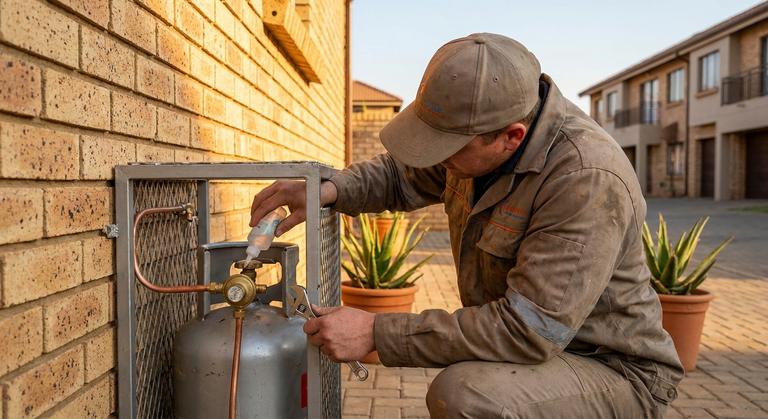
If you manage sectional title units, a rental portfolio or a body corporate scheme, a gas compliance certificate in South Africa is one of those documents that looks trivial right up until a transfer stalls at the conveyancer or an insurer asks for it after a kitchen fire. Load-shedding pushed gas hobs, gas geysers and patio heaters into thousands of homes that were never designed for them, and plenty of that work was done by whoever could get there that week. The certificate - properly a Certificate of Conformity, or CoC - is your only real proof that the installation was done to standard by someone legally allowed to sign it off. Here is when you actually need one, who may issue it, what drives the price, and how to keep the paperwork straight across a portfolio.
What a gas compliance certificate in South Africa actually is
The legal spine is the Occupational Health and Safety Act 85 of 1993 and the Pressure Equipment Regulations made under it. Those regulations require a gas installation to be certified as conforming to the applicable national standard, and for LPG in homes and most commercial premises that standard is SANS 10087-1. The certificate is issued by an authorised person - an installer registered with SAQCC Gas, the South African Qualification and Certification Committee for Gas, which sits under the Department of Employment and Labour with industry oversight from the LP Gas Safety Association of Southern Africa.
A valid CoC is a specific document. It carries a serial number, the installer's SAQCC registration number, the property address, a list of every appliance and cylinder covered, and a signed declaration that the installation conforms to the standard. It is not a service sticker, not an invoice from the shop that sold the hob, and not a letter on a plumber's letterhead saying the gas is fine.
Check the card, not just the certificate
SAQCC registration is issued by category. Domestic and commercial LPG, gas reticulation, autogas, refrigeration and welding are separate authorisations, and a card for one does not cover another. Ask for the physical card at the visit, check the photo, the registration number and the expiry date, and photograph it for your file. It takes thirty seconds and it is the highest-value check in the whole process, because a certificate signed by an unregistered person protects nobody.
When you need a gas CoC
The trigger list matters far more than any calendar. You need a certificate when:
- A new gas installation is completed - hob, gas geyser, fireplace, braai point, a bulk installation, anything fixed.
- An existing installation is altered, extended or moved - a second appliance added, the cylinder cage relocated, pipework re-routed during a renovation, a regulator swapped out.
- The property changes hands. Conveyancers routinely require a gas CoC on transfer where a fixed installation exists, alongside the electrical certificate. Missing paperwork here is a classic cause of delayed registration.
- The user changes. In practice that means a new tenant moving into a unit with a fixed gas installation, and it is the trigger managing agents skip most often.
- After an incident, a suspected leak or emergency repair work.
- Your insurer, the scheme's insurer or a municipal fire officer asks for it.
For commercial premises where staff work around gas, the OHS Act's general duty on employers sits over the top of all of this. If a tenant runs a restaurant kitchen on your property, certification is not optional, and it is worth writing into the lease who holds the certificate and who pays to renew it.
What generally falls outside it
A cylinder connected to a portable braai or a mobile patio heater with a short hose is treated differently from a fixed installation. The boundary is easier to get wrong than people think - the moment a hose runs through a wall, into a cupboard or onto a permanent bracket, you are usually in fixed-installation territory. Ask the installer to tell you which side of the line each setup falls on, and write the answer down.
How long a gas CoC lasts
This is where habits from the electrical CoC mislead people. Gas certification is event-driven rather than date-driven: a gas compliance certificate in South Africa speaks to the installation exactly as it was on the day it was inspected. Change the installation and the certificate no longer describes reality, whatever date is printed on it.
Two practical consequences for a managing agent:
- Insurers and conveyancers often want something recent regardless of the legal position. Read the policy wording and the sale agreement rather than assuming an old certificate carries you.
- Build your own re-inspection rhythm. A defensible portfolio policy is to re-certify on tenant change, on any alteration, before transfer, and otherwise on a diarised cycle you can point to if anyone asks.
What a gas compliance certificate costs in South Africa
We are not going to quote you a rand figure, because pricing swings hard by province, travel distance, installation size and how much remedial work the installer finds on site. What is genuinely useful is knowing how a quote is built, so you can read one properly and compare like for like:
- Base inspection or call-out fee - covers the site visit, the leak test and the certificate admin.
- Per-appliance or per-point charge - a single hob is not the same job as a hob, a gas geyser and a fireplace running off one manifold.
- Travel - meaningful for properties outside the metros.
- Remedial work - the real variable. Perished hoses, the wrong regulator, missing cylinder restraints, inadequate ventilation, cylinders sited too close to doors, windows, drains or electrical points. Nothing gets certified until these are put right.
- Re-inspection - some installers include one return visit in the price, others charge again.
- Urgency and after-hours - a same-week or Saturday slot ahead of a transfer date usually carries a premium.
Three things to insist on. First, no firm quote for the certificate over the phone without sight of the installation; anyone who does that is guessing or selling paper. Second, get remedial work quoted separately from the inspection so you can see exactly what you are paying for. Third, never buy a certificate only. A CoC issued without a proper inspection is worthless in an insurance claim and dangerous in an occupied home.
Getting two or three comparable quotes is the fastest way to sanity-check a number in your area. Platforms like PlanaJob let property managers compare quotes from vetted contractors side by side instead of phoning around, which matters when you are certifying twelve units before month-end. Our guide for South African property managers covers how to structure repeat compliance work like this.
Body corporates: who is responsible for what
Sectional title is where gas compliance gets genuinely messy. The rough split:
- Common property - bulk LPG installations, shared cylinder cages, reticulated pipework in ducts and risers, and gas points serving common areas. This falls to the body corporate under the trustees' maintenance duty in the Sectional Titles Schemes Management Act.
- Inside a section - the owner's appliances and the pipework serving them.
The friction sits at the join, particularly in schemes that reticulate gas from a central bank to individual units. Resolve it in writing before you need to. Practical steps for trustees and managing agents:
- Commission a scheme-wide gas audit so you know what actually exists, not what the plans say.
- Adopt a conduct rule requiring any owner installing gas to lodge a copy of the CoC with the managing agent.
- Keep one register of certificates by unit, with the installer's SAQCC number recorded against each.
- Check what the scheme's insurance policy says about gas installations before renewal, not after a claim.
- Where an owner refuses to certify, follow the scheme's internal process and escalate through CSOS rather than letting it drift.
Finding an installer who can actually certify
Not every gas fitter can issue a gas compliance certificate in South Africa - only a registered authorised person in the right category can. Demand is real and seasonal too, because transfers cluster and winter heating work competes for the same diaries. If you run a portfolio, build a relationship with two or three registered installers rather than starting cold every time. Screen on the SAQCC card and category, willingness to inspect before quoting, a separate remedial quote, and issue of the official CoC form rather than a note on a letterhead.
Contractors reading this from the other side: compliance-led work is some of the most defensible revenue in the trades, because it recurs on triggers clients cannot skip. There is good thinking on building a business around that kind of demand on Construction Arbitrage, and certification-gated trade businesses tend to hold their value when owners eventually sell, which Contractor Exit covers well.
Find SAQCC-registered gas installers on PlanaJob for same-week certification. Create a free account, post the job with the property address and appliance list, and compare quotes from installers who can produce a valid registration card. More compliance guides for South African property managers sit on the PlanaJob blog.
FAQ
Does a gas compliance certificate in South Africa expire?
Gas certification is event-driven rather than running on a fixed clock like the electrical CoC most property managers are used to. The certificate reflects the installation on the date it was inspected, so any alteration, addition or relocation makes it out of date immediately. Insurers and conveyancers may still ask for a recent certificate, so check the policy wording and the sale agreement instead of relying on an old document.
Who can legally issue a gas CoC?
Only an authorised person registered with SAQCC Gas in the correct category for that installation. A general plumber, handyman or appliance retailer cannot issue one, and a certificate signed by an unregistered person offers you no protection at all. Always ask to see the registration card and record the number on your file.
Do I need a new gas CoC every time a tenant changes?
Re-certifying on tenant change is the safest default and it is the trigger most portfolios miss. A new occupant inherits an installation they did not commission and cannot vouch for, and a fresh inspection gives you a dated record that the hoses, regulator, ventilation and cylinder siting were sound at handover. It also creates the natural moment to walk the tenant through the isolation valve and what to do if they smell gas.