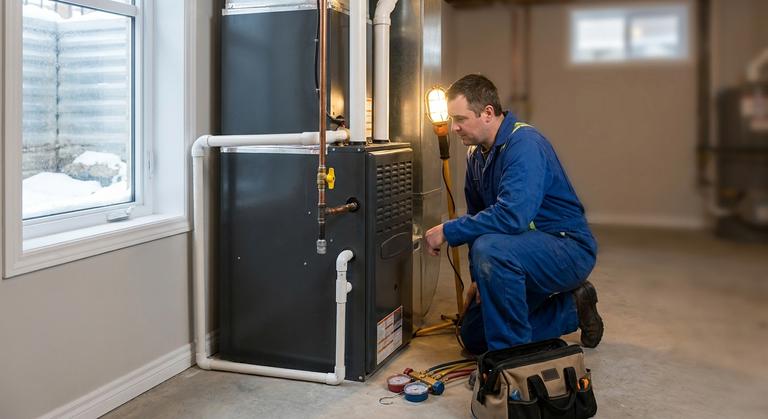
Search "furnace replacement cost Canada" and you get a tidy national average that falls apart the moment you are standing in a Winnipeg basement in January with a red-tagged unit and a tenant on the phone. What lands on your desk in CAD depends on fuel type, venting, duct condition, electrical capacity, provincial permit rules and how far the nearest supply house sits from the property. This guide covers the six items that actually move the number, what changes province by province heading into 2026, and how to read three HVAC quotes so you are comparing the same job instead of three different ones.
Furnace Replacement Cost in Canada: The Six Real Cost Drivers
Two similar furnaces in two similar basements can land thousands apart. It is almost never the box that explains the gap.
1. Equipment tier and efficiency
Single-stage units sit at the bottom of the range. Two-stage and modulating furnaces with variable-speed ECM blowers cost more up front but run quieter, which matters in duplexes and stacked townhouses where noise turns into a complaint. Condensing high-efficiency equipment is now the mainstream choice across most of the country.
2. Venting and combustion air
Moving from a mid-efficiency unit to a condensing one means new sidewall venting, a condensate drain and a fresh air intake. If the old furnace shared a masonry chimney with the water heater, pulling it off that chimney orphans the tank and triggers its own work: a liner, a power-vented replacement, or both. This is the most common reason one quote is far higher than another. One contractor priced the chimney; the other left it out.
3. Ductwork and sizing
Undersized returns are everywhere in older Canadian housing stock, and a new high-static blower on tired ducts produces noise, short cycling and callbacks. A serious quote includes a CSA F280 style heat loss calculation rather than copying the BTU rating off the old label. Oversizing is the default error in cold-climate installs.
4. Gas line and electrical
A higher input rating can mean an upsized gas line or a regulator change. Condensate pumps, dedicated circuits and panel capacity all show up as line items, especially in older buildings where the panel is already full.
5. Permits, inspection and licensing
Gas and HVAC work is provincially regulated: TSSA in Ontario, Technical Safety BC, licensed gas fitters under RBQ rules in Quebec, and provincial safety authorities elsewhere. Permit fees and inspection lead times are municipal and vary widely. A quote with no permit line is a red flag, not a saving.
6. Access, removal and disposal
Tight stairwells, crawlspaces, elevator bookings in a mid-rise, suspect wrap on old ductwork that needs assessment before anyone cuts, and haul-away of the old unit. Access is the item property managers forget and contractors price.
How Furnace Replacement Cost Varies by Province
Anyone quoting one national figure for furnace replacement cost in Canada is averaging Yellowknife freight against Calgary competition. Fuel availability, labour supply, rebate programs and climate design temperature all pull it around.
British Columbia
Natural gas is widely available in the Lower Mainland and the Interior, but incentive programs and the direction of the BC energy step code lean toward electrification. A like-for-like gas swap is often the least-subsidized route, while a dual-fuel heat pump pairing tends to attract the most program support.
Alberta and Saskatchewan
Deep cold design temperatures make sizing and staging matter more here than anywhere else, and gas remains the default. Install markets in Calgary, Edmonton, Regina and Saskatoon are competitive, but rural properties pick up travel and after-hours charges that city quotes do not carry.
Manitoba
Low hydro rates make cold-climate heat pumps and electric backup easier to defend on operating cost, and Efficiency Manitoba runs its own programs. Winnipeg winters still argue for a correctly sized furnace as the backbone.
Ontario
The largest contractor pool in the country and the widest quote spread. Gas work needs TSSA-certified fitters, permit timelines differ sharply between Toronto and smaller municipalities, and utility efficiency programs change year to year, so confirm what is open before you build a budget around a rebate.
Quebec
Very low electricity rates and provincial programs aimed at moving buildings off oil and gas change the maths outright, and an electric or heat pump conversion is often the better long-run play. Montreal has moved to restrict fossil fuel heating in new construction, so check municipal rules before specifying gas in a redevelopment.
Atlantic Canada
Oil-fired furnaces remain common in Nova Scotia, New Brunswick, PEI and Newfoundland and Labrador, and some areas have no natural gas distribution at all. Replacements often become conversions: tank decommissioning, insurer sign-off and a bigger electrical scope. Budget a wider range than a straight gas swap.
The Territories
Freight, a short working season and a thin pool of licensed fitters put Yukon, the Northwest Territories and Nunavut at the top of any national range. Order equipment early; a February failure with nothing on the ground is the expensive scenario.
How to Read Three HVAC Quotes Line by Line
Most of the variance in furnace replacement cost across Canada is scope, not equipment. Put the quotes side by side and check:
- Make, model, AFUE and input rating in BTU/h, not just "high-efficiency furnace".
- Whether a heat loss calculation was done and whether sizing came from it.
- Venting: new run, termination point, condensate drain and pump.
- Water heater orphaning: addressed or ignored.
- Gas line and regulator upsizing: included or excluded.
- Electrical: dedicated circuit, disconnect, any panel work.
- Thermostat, filter cabinet and duct modifications.
- Permit, inspection and removal of the old unit.
- Warranty: manufacturer parts term, installer labour term, and the registration deadline after install.
- Payment schedule and what triggers a change order.
A quote that comes in 30 per cent cheaper usually differs on items 3, 4, 5 and 8. Spread is not automatically gouging either: labour rates, overhead and warranty risk get priced differently by every shop, and Construction Arbitrage is a useful read if you want the contractor-side view of how those numbers get built.
Permits, Heat Obligations and Timing
Heat is treated as a vital or essential service under provincial residential tenancy legislation, and many municipalities set both a minimum indoor temperature and a defined heating season. A furnace failure in a tenanted unit is not a next-spring item; delay exposes you to tenancy board applications and emergency-rate invoices at once. Replace in the shoulder season when you have the choice, because quotes are lower, crews are free and permit queues are shorter than in the first cold week of November. If you run multiple buildings, the PlanaJob tools for Canadian property managers are built for raising this kind of job across a portfolio rather than one address at a time.
Rebates, Financing and What Waiting Costs
Program lists change, so verify what is live when you buy rather than trusting last year's blog post. Worth checking before you commit:
- Federal retrofit loan programs and their current eligibility rules.
- Provincial and utility programs: CleanBC Better Homes, Efficiency Manitoba, Efficiency Nova Scotia, Hydro-Quebec and Energir offerings, and Ontario utility programs.
- Manufacturer spring and fall promotions, which often beat rebate value on a straight gas swap.
- Whether a cold-climate or dual-fuel heat pump improves your rebate position enough to offset the higher install.
One warranty note: HVAC is a consolidating trade and shops change hands regularly, a market tracked over at ContractorExit, so confirm who carries the labour warranty if the company is sold. Manufacturer parts coverage follows the equipment; installer labour coverage does not always follow ownership.
Compare Vetted HVAC Quotes Before the First Cold Snap
The fastest way to pin down furnace replacement cost in Canada for your specific building is three itemized quotes on identical scope, in CAD, from licensed fitters who have actually seen the basement. Platforms like PlanaJob let property managers post the job once and compare quotes from vetted contractors side by side, which beats chasing callbacks in a cold week. Create a free PlanaJob account and get quotes in before the first cold snap, and find more cost guides for Canadian PMs on the PlanaJob blog.
FAQ
Is it cheaper to repair or replace a furnace?
Past roughly 15 years, a failed heat exchanger, control board or inducer motor usually tips the decision to replacement, since those are the costliest parts and the rest of the unit is close behind. A cracked heat exchanger is a red-tag condition, not a repair decision. Under 10 years with one failed component, repair is normally the better call.
How long does a furnace replacement take?
A like-for-like swap is typically one day. Add a day or more for chimney liner work, duct modifications, an oil conversion or an electrical upgrade. Permit and inspection scheduling can stretch the calendar even when the labour itself is short.
Should I install a heat pump instead of a new furnace?
In Quebec, British Columbia and Manitoba, where electricity is cheap, a cold-climate heat pump with furnace or electric backup often wins on total cost of ownership. In Alberta and Saskatchewan, low gas prices and extreme design temperatures still favour a high-efficiency furnace, sometimes in a dual-fuel pairing. Ask each contractor to quote both so the furnace replacement cost sits next to the alternative on the same page.