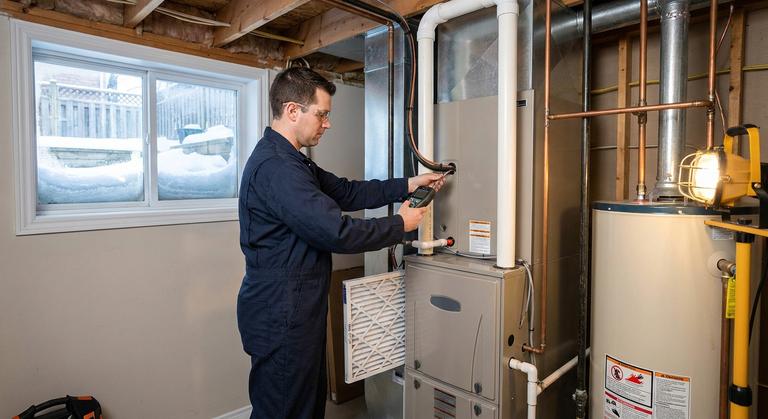
Every property manager in Canada learns the same lesson the same way: a furnace quits at 2 a.m. on the coldest night in January, the tenant calls, and every HVAC company within 50 km is booked three days deep. A furnace maintenance schedule rental properties can actually sustain is the cheapest insurance you will ever buy against that call. Below is how often furnaces genuinely need servicing in Canadian conditions, what a proper tune-up covers, how to set filter intervals that match the equipment rather than the calendar, and how to keep records that hold up in a warranty claim or a tenancy hearing.
How Often a Rental Furnace Actually Needs Servicing
Once a year, before heating season. That is the answer for the vast majority of gas and propane furnaces in Canadian rentals, and it is what most manufacturers' warranty terms expect: documented annual servicing by a licensed technician.
The reason is duty cycle. A furnace in Winnipeg or Sudbury can run seven or eight months a year, cycling thousands of times. Wear items degrade on run hours, not calendar years. A flame sensor quietly builds an oxide film all winter, and the unit that behaved perfectly in March fails its ignition sequence in November.
Rentals add a second reason. Owner-occupiers notice the small stuff: the odd short cycle, the burner that hesitates, a new rattle in the blower. Tenants often report none of it until there is no heat at all. Your annual visit is the only time anyone is genuinely looking at the equipment.
When twice a year makes sense
Move to a spring-and-fall cadence for:
- Furnaces over 15 years old, or any unit with two or more repairs in the past two seasons
- Systems sharing a blower and coil with central air or a heat pump, which run year-round
- Student rentals, rooming houses and high-turnover units where filters get ignored
- Homes with several pets, or properties near gravel roads, renovations or ongoing construction
- Any unit where a tenant has raised an air quality or odour concern
What a Real Furnace Tune-Up Covers
"Cleaned and checked" on an invoice means nothing. Ask your contractor to confirm in writing that the visit includes:
- Combustion analysis with a calibrated analyzer, including CO in the flue
- Manifold gas pressure verified against the nameplate with a manometer
- Temperature rise measured and compared to the rated range on the data plate
- Total external static pressure measured across the air handler
- Burners and flame sensor cleaned, igniter resistance checked
- Heat exchanger inspected visually, with a camera where access allows
- Inducer and blower amp draw checked, blower wheel cleaned if loaded
- Condensate trap, drain line and neutralizer flushed or replaced
- Intake and exhaust vent terminals checked for clearance and blockage
- Pressure switch, rollout switch and high limit tested rather than assumed
- Thermostat operation, wiring connections and CO alarms verified
- A written report with the actual readings, not just checkmarks
The first four items are what separate a real service from a wipe-down, and the recorded numbers give you a baseline: next year's technician can see that static pressure climbed or temperature rise drifted, and catch a duct or blower problem before it becomes a callout.
The condensate and venting problem nobody budgets for
High-efficiency condensing furnaces are standard across Canada now, and they bring two failure modes that are close to uniquely ours. Condensate lines running through unheated crawl spaces or garages freeze and back up, tripping the pressure switch and shutting the unit down. PVC vent terminals get buried by drifting snow, glazed over by ice from a dripping soffit, or plugged by a snowbank a plow pushed against the wall. Add a post-storm terminal check to your winter routine, and tell tenants to keep a path clear around the two white pipes.
Filter Schedules That Match the Equipment
Filter intervals depend on filter depth and household conditions, not a blanket rule:
- 1 inch pleated or fibreglass: inspect monthly, replace every one to three months. Assume monthly through heating season in a pet household or a busy family unit.
- 4 or 5 inch media cabinet: replace every six to twelve months. Once a year is realistic in a quiet two-person unit, twice with pets.
- Electronic air cleaner cells: wash on the manufacturer's interval and make sure the tenant knows they are washable, not disposable.
- HRV filters: clean or replace at least twice a year. They get forgotten because they sit in a different box.
On MERV, the honest answer is that MERV 8 to 11 suits most residential systems. Going higher on ductwork that was already undersized raises static pressure, overworks the blower and can trip the high limit on a cold day. If a tenant wants a higher-rated filter for allergy reasons, have your technician measure static pressure first.
Who actually changes the filter
You can supply filters and ask tenants to swap them, and that works well when you leave a labelled stack of the right size in the mechanical room with the airflow arrow direction noted. What you cannot do is transfer the underlying obligation. Provincial residential tenancy legislation across Canada puts responsibility for maintaining a working heating system on the landlord, and many municipalities set a minimum indoor temperature during heating season, with Toronto's bylaw requiring 21°C. If a tenant never changes the filter and the blower burns out, it is still your repair.
Building a Furnace Maintenance Schedule Rental Portfolios Can Run
The single biggest win is booking early. Every HVAC company in the country is oversubscribed from October onward, and both rates and response times reflect it.
- May and June: review last season's callouts, flag units for replacement, confirm contractor licensing and insurance
- July to September: run every annual tune-up, grouped by neighbourhood to cut travel time
- October: test CO and smoke alarms, distribute filters, send tenants a short cold-weather note
- November to February: post-storm vent terminal checks, mid-season filter swaps
- March and April: condensate and drain check, close out warranty paperwork
Give proper entry notice for every visit. Most provincial tenancy acts require written notice, commonly 24 hours, stating the reason and a time window. Batch bookings by street or building so one notice run covers a full day of work.
Platforms like PlanaJob let property managers post the whole seasonal batch once and compare quotes from vetted contractors instead of phoning five companies in September. If you manage more than a handful of doors, that changes how the entire fall goes, and you can see how it works for property managers in Canada.
Repair, Replace, or Plan Ahead
Most furnaces reach the end of their service life somewhere between 15 and 20 years. The signals to start planning are a cracked or corroded heat exchanger, parts that are no longer stocked, and a second no-heat callout in one season. Replacement in July costs less and stresses nobody. Replacement in January costs more and can mean paying for a hotel.
Treat heating capital as a portfolio question rather than a per-unit panic; there is useful thinking on that kind of planning at Construction Arbitrage. Watch the ownership side too, because HVAC firms change hands often and consolidation is reshaping who actually turns up at your door. When a trusted contractor sells the business, the crew and the pricing usually change with it, a market documented at Contractor Exit. Keep a second qualified contractor in your rotation.
Put Annual Tune-Ups on Autopilot
The property managers who never take the January no-heat call are not luckier. They booked in August, they hold written readings from last year, and they know which three units are on borrowed time. You can set up a free account, schedule your annual tune-ups across the whole portfolio in one pass, and reuse the same job template every season, which is the simplest way to keep a furnace maintenance schedule rental owners can defend at a tenancy hearing. More seasonal maintenance playbooks sit on the PlanaJob blog.
FAQ
Do I need a licensed technician to service a furnace in Canada?
Yes for anything touching the gas train, burners, venting or combustion. Gas work is regulated provincially: Ontario requires a TSSA-registered contractor with a certified gas technician, British Columbia works through Technical Safety BC, Alberta through its certified gas fitter system, and Quebec through licensed contractors. Filter changes and clearing snow off vent terminals are the only tasks an unlicensed person should handle.
Can I make the tenant responsible for furnace maintenance in the lease?
You can ask a tenant to change filters and report problems, and it is reasonable to set that expectation in writing. You cannot contract out of your statutory duty to maintain the heating system under provincial tenancy law, so the annual professional service stays in your hands and your budget.
What should a tenant do if the furnace stops during a cold snap?
Give every tenant a one-page card at move-in: check the thermostat batteries and setting, check the furnace switch and the breaker, check that the intake and exhaust pipes outside are clear of snow, then call your emergency line. If there is any smell of gas or a CO alarm sounds, they leave the building first and call 911 or the gas utility from outside.