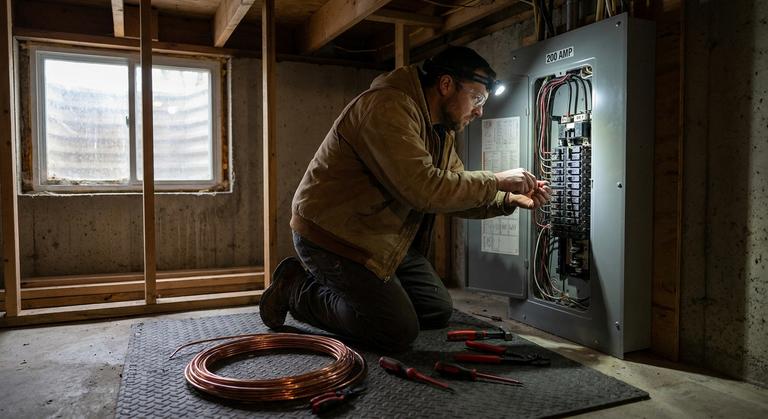
Electrical work gives property managers almost no room to improvise: it is provincially regulated, illegal to hand to an unlicensed handyman in most of the country, and priced with wide variation between contractors. This guide breaks down electrician cost in Canada for property managers and landlords - how hourly rates are actually structured, what belongs in a panel upgrade quote, and what your options are when a 1970s building turns out to have aluminum wiring. The goal is to help you understand what moves the price, so you can keep every quote honest.
What Drives Electrician Cost in Canada
There is no national rate card. Electricians are licensed province by province, rates track local labour markets, and the same job can be priced very differently in downtown Vancouver than in rural New Brunswick. Before you compare numbers, it helps to understand how those numbers are built.
Hourly rates, service calls, and minimums
Most residential electricians bill in one of two ways. Small repair work usually runs on a service call structure: a fixed fee to attend, often covering the first block of time, then an hourly rate after that. Defined jobs - a panel swap, an EV charger circuit, a lighting retrofit - are more often quoted flat. On larger jobs you may see blended crew rates, with a journeyperson supervising apprentices billed at lower rates. Evening, weekend, and emergency callouts carry premiums almost everywhere.
When you collect quotes, ask three questions every time:
- How is the first hour billed, and is travel time included?
- Is this a fixed price or an estimate, and what triggers extras?
- Are sales taxes and permit fees included? GST, PST, and HST treatment varies by province, and a low quote sometimes just leaves them off.
Why two quotes for the same job can be far apart
A big spread rarely means someone is ripping you off. It usually means the quotes do not cover the same scope. Common gaps: one includes the permit and inspection while the other does not; one includes patching walls after fishing cable while the other stops at the electrical work; one prices disposal of the old panel while the other leaves it in your parkade. Overhead matters too - an established firm with employees, vehicles, and proper insurance carries costs a solo operator does not, and business-of-construction reading like Construction Arbitrage is a useful window into how contractors actually build their pricing. Neither model is wrong; you are buying different levels of capacity and warranty backing.
Licensing: What You Are Actually Paying For
Part of electrician cost in Canada is the licence behind the invoice, and that is a feature, not a bug.
Provincial regulators, not a national one
- In Ontario, electrical contracting businesses must be Licensed Electrical Contractors registered with the Electrical Safety Authority (ESA), and hiring anyone else for electrical work is not permitted.
- In British Columbia, Technical Safety BC licenses electrical contractors and certifies the field safety representatives who take out permits.
- In Quebec, electrical work is restricted to licensed electrical contractors under the RBQ regime.
- Across the country, the interprovincial Red Seal endorsement is the standard marker of a fully qualified journeyperson.
Before you shortlist anyone, ask for the licence number and verify it with the provincial regulator. It takes minutes and instantly filters out the riskiest quotes.
Permits and inspections are part of the real cost
Nearly everything in this guide - panel upgrades, new circuits, aluminum wiring remediation - requires a permit or notification, followed by an inspection. A quote that quietly omits the permit is not cheaper; it is incomplete, and the gap can surface later at insurance renewal or when the building sells. When comparing electrician costs in Canada, insist that every quote states who files the permit and includes the fee.
Panel Upgrades: The Big-Ticket Line Item
For most property managers, the service upgrade is where electrical budgets get serious, so it deserves the most scrutiny.
When you actually need one
Demand for panel upgrades has climbed with EV chargers, heat pumps, in-suite laundry, and secondary suites. Many older buildings still run 60 or 100 amp services that were fine for their era but struggle with electrification. That said, do not assume you need a 200 amp upgrade just because a tenant wants a charger. Ask for a load calculation first: it is a standard exercise under the Canadian Electrical Code and often shows more headroom than expected. Recent code editions also permit load management devices, such as EV energy management systems, which share capacity intelligently and can defer a full service upgrade entirely. A good electrician will offer that analysis before selling you the bigger job.
What a complete panel upgrade quote includes
- Permit or notification fees and the final inspection.
- Utility coordination for the disconnect and reconnect.
- The panel, breakers, and any service mast or meter base work.
- Grounding and bonding brought up to current code.
- Labour, including making good any wall or ceiling openings.
- Removal and disposal of the old equipment.
If a quote is silent on any of these, ask. The cheapest number on paper is often the most expensive one by the end.
Aluminum Wiring: The 1970s Problem That Follows Your Insurance
Why it matters
A large share of Canadian homes and low-rise buildings wired from the mid-1960s to the mid-1970s used aluminum branch wiring. Aluminum itself is not banned - utilities still use it for service conductors - but older branch circuit connections can loosen and oxidize over time, creating heat at outlets, switches, and junctions. The conversation is really about connections, not about tearing out every metre of cable.
Your three remediation options
- CO/ALR-rated devices: replacing receptacles and switches with devices rated for aluminum conductors, installed to spec. The lightest-touch fix.
- Copper pigtailing: joining a short copper lead to each aluminum conductor with a connector approved for the purpose, so devices only ever touch copper. This is priced per connection, so quotes are usually built from a device count.
- Full rewire: the most disruptive and most expensive path, usually reserved for buildings undergoing major renovation anyway or where the wiring has broader condition issues.
The right choice depends on the building, the insurer, and your renovation plans - which is exactly what you want quoting electricians to address in writing.
The insurance angle
Most Canadian insurers ask about aluminum wiring, and many require an inspection or proof of remediation before binding or renewing coverage; in Ontario that typically means an ESA inspection. If you are acquiring a 1960s or 1970s building, price this into due diligence rather than discovering it at renewal time.
Keeping Electrical Costs Under Control Across a Portfolio
- Batch small jobs. Ten repairs across three buildings on one visit schedule beats ten separate service calls.
- Standardize fixtures and devices across units so electricians are not chasing obscure parts.
- Get load calculations before approving upgrades, for the reasons above.
- Keep permit and inspection records centrally; they are gold at refinance, sale, and insurance renewal.
- Compare at least three quotes on anything beyond a service call. Platforms like PlanaJob make this practical by letting you post a job once and compare quotes from vetted contractors instead of phoning around.
If you manage at scale, the PlanaJob property managers page shows how portfolio workflows handle exactly this, and you will find more cost guides on the PlanaJob blog.
One last point on vetting: PlanaJob lists only licensed electricians - ESA-registered contractors in Ontario, Technical Safety BC licence holders out west - so every quote you compare starts from the same regulatory baseline. If your next job is a panel upgrade or an aluminum wiring assessment, create a free account and get comparable quotes instead of guesses.
FAQ
What is a typical electrician hourly rate in Canada?
There is no single national number, and any article that gives you one is guessing. Rates track local labour markets, licence class, and demand, so downtown Toronto and rural Manitoba are different worlds. The practical move is to gather three structured quotes for your actual job in your actual city - that tells you the real electrician cost in Canada for your market better than any average.
Do I have to remove aluminum wiring from a rental property?
Not necessarily. Remediation ranges from CO/ALR devices to copper pigtailing to a full rewire, and the right choice depends on the building's condition and what your insurer will accept. Have a licensed electrician inspect the connections, put their recommendation in writing, and confirm it satisfies your insurance before work starts.
Can my superintendent or handyman do small electrical repairs?
In most provinces, no. Electrical work done for others must be carried out by licensed contractors - in Ontario only a Licensed Electrical Contractor may be hired for electrical work, and BC and Quebec run their own strict regimes. Changing a light bulb is fine; changing a receptacle in a tenant's unit is electrical work. The potential fines, insurance exposure, and liability all outweigh whatever a handyman saves you.