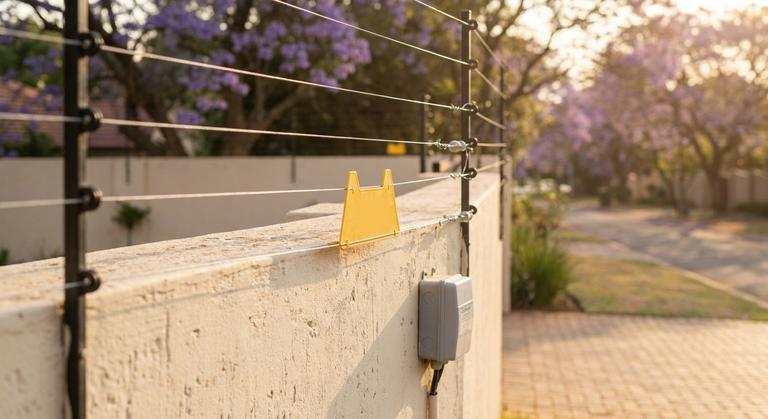
If your scheme or rental property has an electric fence on the boundary wall, someone carries the legal duty for it, and in a sectional title scheme that someone is almost always the body corporate. An electric fence certificate of compliance is not a nice-to-have document that gets filed and forgotten. It is a legal instrument under the Electrical Machinery Regulations, it is triggered by specific events rather than by a calendar, and its absence can stall a transfer or leave a scheme badly exposed after an incident. Trustees, managing agents and landlords who know what triggers a certificate, who may issue one, and what quietly invalidates the one already in the file avoid the two worst outcomes: a panicked week before registration, or an injury claim with no paperwork behind it.
What the law actually requires
Electric fences are dealt with in Regulation 12 of the Electrical Machinery Regulations, 2011, made under the Occupational Health and Safety Act 85 of 1993. Two obligations sit at the heart of it. The system must comply with SANS 10222-3, the national standard for electric security fences, and the user or lessor must hold an electric fence certificate of compliance issued by a person registered with the Department of Employment and Labour as an electric fence system installer.
The wording "user or lessor" matters more than most trustees realise. The duty attaches to whoever uses or controls the system, not simply to whoever appears on the title deed. A fence on the boundary wall of a sectional title scheme sits on common property, so the body corporate is the user. A fence on a house you let out makes you, the landlord, the lessor.
It is also a completely separate document from the electrical installation certificate of compliance issued under the Electrical Installation Regulations. Different regulation, different prescribed form, different registered person. Your electrician's CoC covers the distribution board and the wiring, and it says nothing about the fence. Plenty of trustees discover this seven days before a transfer.
When you actually need an electric fence certificate of compliance
The regulation ties the certificate to events, not to an annual cycle:
- A change of ownership of the premises on which the system is installed, where that change of ownership took place after 1 October 2012.
- Any addition or alteration to an existing system carried out after that date.
There is no expiry date printed on the certificate and no legal requirement to renew it every year or two. Once issued for a system, it stands until one of those triggers occurs. That sounds generous until you realise how easily the second one is pulled.
An alteration is not only a brand new installation. Adding strands, replacing or relocating the energiser, extending a wall, adding a gate or pedestrian zone, splitting the fence into zones, rerouting conductors after cable theft, or tying the system into a new alarm panel all change the system that was certified. The practical test for trustees: if a contractor changed the physical configuration or the energiser, assume a fresh certificate is needed and make the installer confirm otherwise in writing.
The classic failure is a repair after a break-in. The security company attends, re-tensions the line, adds two strands over the low section, invoices and leaves. No certificate is issued. The scheme's file still holds a document describing a system that no longer exists.
Who may issue the certificate
An electric fence certificate of compliance may only be issued by a registered electric fence system installer. Not a general electrician, not a PSIRA-registered guarding company, and not the complex handyman who is good with tools. Registration is granted by the Chief Inspector, and the installer's registration number must appear on the certificate along with the prescribed test results.
Vetting an installer before you appoint
- Ask for the registration document and number, and check it is current and in the name of the person who will actually sign your certificate, not a colleague's.
- Confirm which form they will issue and that a test report forms part of it.
- Ask whether the quoted price covers testing only, or testing plus remediation. A test-only quote that comes back "non-compliant" is the most common bill shock trustees face.
- Ask them to itemise signage, energiser, earthing and gate work separately so you can compare quotes line by line.
- Take at least three quotes for anything beyond a straight test.
Scope is where the money hides. The gap between the cheapest and the most expensive quote on the same fence is usually a scoping difference rather than a rate difference. Platforms like PlanaJob let property managers raise the job once and compare quotes from vetted contractors side by side, which makes those scope gaps obvious instead of invisible. If you want to understand how contractors price compliance work of this kind, constructionarbitrage.com is a useful read on procurement and margin behaviour in the trades.
One continuity point worth noting: installer businesses change hands and close more often than schemes expect, and sites like contractorexit.com exist precisely because trade businesses get bought and sold. Do not assume the company that certified your fence in 2019 still trades under the same name when you need a duplicate of the paperwork.
Sectional title schemes: whose certificate is it?
Where the fence sits on common property, the body corporate is the user and the electric fence certificate of compliance belongs in the scheme's records, not in an individual owner's file. The Sectional Titles Schemes Management Act and the prescribed management rules already oblige trustees to keep common property in a state of good repair, and the fence is no different from the gate motors or the fire equipment in that respect.
Treat the certificate as a scheme document: original in the scheme file, digital copy with the managing agent, and a standing item alongside the insurance valuation and fire equipment service records at every AGM.
The transfer question trustees keep hitting
When a section sells, the conveyancer will ask the seller for the electrical certificate of compliance for the unit. Where the electric fence is on common property, the seller cannot produce a fence certificate for infrastructure they do not individually control. The practical answer is that the body corporate holds a valid one and the managing agent issues a copy on request within a day.
The picture differs where a fence serves an exclusive use area, a freestanding house in an HOA estate, or a scheme where sections have their own boundary walls. There the owner is far more likely to carry the duty personally. Practice among conveyancers is not uniform, so raise it early with the attorney rather than in transfer week, and make sure the scheme gives the same answer every time it is asked.
Landlords and the lessor duty
If you let a property with an electric fence, the duty is yours and not your tenant's, even when the tenant pays the armed response subscription. Two habits protect you.
First, write into the lease that no alteration to the fence may be made without your written consent, and that all fence work goes through your registered installer. A tenant asking a security company to "add a few strands" is an alteration, and it is your electric fence certificate of compliance that goes stale as a result.
Second, record the fence in the ingoing inspection, note where the isolator is, and give the tenant the installer's emergency number. Property managers running multiple mandates can standardise this: a fence clause in the template lease and a fence line in the inspection form takes ten minutes to add and removes the argument entirely.
What a compliant fence looks like on site
Before you book an installer, walk the line and note the obvious:
- Warning signs on both sides of the fence, at gates and access points, spaced at the intervals SANS 10222-3 requires, and still legible. Faded or missing signage is the single most common failure item.
- An energiser that carries the correct approval marking and can be isolated safely.
- A dedicated earth for the fence, separated from the electrical installation's earth by the distance the standard requires.
- No live conductor reachable from a pavement, a step, a wheelie bin, a carport roof or a neighbour's wall.
- No conductor touching vegetation, gate motors, palisade sections or an overhanging tree.
- Wall and fence height that complies with your municipal by-laws, which differ between municipalities and sometimes require approval.
None of this replaces a formal test, but it tells you whether you are booking a test or a remediation.
Put it in the maintenance calendar
- Walk the fence line and check signage once a year, and photograph it for the file.
- Log every fence intervention in the maintenance register with the contractor's name and registration number.
- Treat every cable theft repair, storm repair or vehicle impact on the wall as an alteration until the installer confirms in writing that the certified configuration is unchanged.
- Budget signage and energiser replacement into the scheme's ten year maintenance plan instead of funding it through an emergency levy.
PlanaJob connects body corporates and managing agents with certified electric fence installers nationwide, so you can raise the job once, compare quotes and keep the paperwork trail in one place. You can create an account in a few minutes, see how the platform works for property managers, or browse more compliance guides on the PlanaJob blog.
FAQ
How long is an electric fence certificate of compliance valid for?
There is no expiry date. The certificate remains valid for the system it describes until the premises change ownership or the system is altered or added to. In practice, a certificate can be years old and still perfectly valid, while one issued last month is worthless if the fence was changed the following week.
Does every unit owner in a sectional title scheme need their own certificate?
No. Where the fence is on common property, the body corporate is the user and holds one certificate for the scheme's system. Owners of sections with their own boundary walls, or with a fence serving an exclusive use area, may carry their own. Confirm the position with your conveyancer before a transfer rather than during one.
Can our regular electrician issue the certificate?
Only if that electrician is separately registered as an electric fence system installer with the Department of Employment and Labour. A wireman's licence and the ability to issue an electrical installation CoC do not extend to electric fences. Ask for the registration number and check it before work starts.