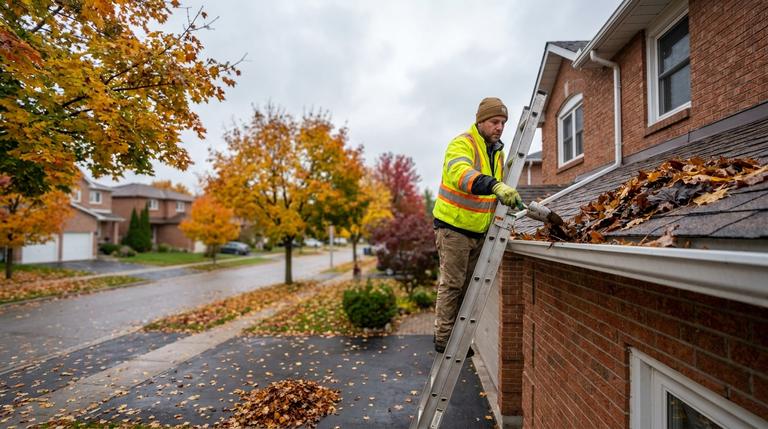
Ask five property managers what they pay to have their troughs cleared and you will get five different answers, and all of them might be right. Eavestrough cleaning cost in Canada varies more than almost any other seasonal line item because the price is driven by height, access, debris load and geography rather than any national rate card. This guide breaks down what actually moves the number, which repairs tend to ride along with a fall clean, and how to turn a scattered pile of quotes into one predictable budget line for your whole portfolio before the snow flies.
Why Fall Cleaning Is a Deadline, Not a Suggestion
Across most of Canada the window between leaf drop and the first hard freeze is only a few weeks. Miss it and wet debris freezes into a solid plug that stays put until spring. A blocked eavestrough in winter contributes to ice damming at the roof edge, meltwater backing up under shingles, rot in fascia and soffits, and downspouts that split when trapped water freezes and expands. Overflowing troughs also dump water straight at the foundation, which is exactly where you do not want it during freeze-thaw season.
The cadence varies by region. In southern Ontario and Quebec, one thorough clean after the maples finish dropping usually carries a building through winter. On the BC coast, conifer needles and moss fall year-round, so many managers schedule two or three visits. On the prairies, cottonwood fluff in early summer can clog troughs long before autumn. Build your schedule around your trees, not the calendar alone.
What Drives Eavestrough Cleaning Cost in Canada
When a contractor prices this work, they are pricing time, risk and access. The main variables:
- Height and storeys. A bungalow reachable from a step ladder is a quick job. A three-storey walk-up needs longer ladders, more repositioning, sometimes fall-arrest gear and often a second person. Height is usually the single biggest multiplier.
- Linear footage and roofline complexity. More metres of trough means more time, and a chopped-up roofline with dormers, valleys and multiple downspouts takes longer than a simple rectangle with two corners.
- Access obstacles. Landscaping under the eaves, fences, decks, sloped ground, parked cars and locked side gates all add ladder-moving time.
- Debris load. A property under mature maples or oaks, or one that skipped last year's clean, holds far more material than a newer build on a treeless street.
- Downspout flushing. Clearing the horizontal run is only half the job. Confirm the quote includes flushing downspouts, because a plugged downspout defeats the whole exercise.
- Gutter guards. Guards reduce debris but do not remove the need for maintenance, and quotes often rise when guards must be lifted and re-seated to clean beneath them.
- Timing and demand. Crews book solid from late October onward. Managers who confirm work in September get better availability and better attention than those calling after the first frost.
How Contractors Price the Work
Most firms quote one of three ways: a rate per linear foot or metre of trough, a flat rate per building type, or an hourly rate covering cleaning plus minor repairs as found. Almost all carry a minimum call-out charge, because the expensive part of a small job is getting a crew and ladders to the address, not the twenty minutes of scooping.
That structure is where portfolio managers find their leverage. Route density is everything in this trade: ten buildings booked as one job on one street costs the contractor far less per building than ten separate call-outs, and a good contractor will price accordingly. If you want to understand that math from the other side of the ladder, the strategy pieces at ConstructionArbitrage are a useful read on how trade businesses price seasonal work.
Two practical notes when comparing eavestrough cleaning costs in Canada: never benchmark a single-address quote against a bundled one, and check whether GST or HST is included, since that differs by province and quietly skews comparisons.
Repairs to Budget Alongside the Clean
The crew on the ladder is your cheapest inspection of the year, so use it. Ask for photos of any defects found, and expect some of these across a portfolio every fall:
- Resealing seams and end caps. Sealant dries out and joints drip. Quick to fix while the trough is clean and dry.
- Rehanging sagging sections. Old spike-and-ferrule fasteners work loose over years of freeze-thaw. Replacing them with screw-in hangers is a standard, inexpensive upgrade.
- Correcting slope. A trough that has settled flat or backwards holds standing water, which becomes ice, which pulls the trough further off line every winter.
- Reattaching and extending downspouts. Elbows split, straps loosen and extensions get kicked off. Water should discharge well clear of the foundation. Some municipalities also have rules about downspouts and storm sewer connections, so check local bylaws before changing the configuration.
- Replacing crushed or split sections. Sectional replacement is routine; a full-perimeter replacement is a capital job to plan separately.
- Fascia and soffit findings. Rot behind the trough is the expensive discovery. Caught early it is a small carpentry repair rather than a roofline rebuild.
Hold a repair contingency on top of the cleaning budget, sized from last year's actual repair spend across the portfolio rather than a guess.
Building a Portfolio Budget That Survives October
Here is the method that turns eavestrough cleaning cost in Canada from an annual surprise into a boring, predictable line item:
- Inventory the portfolio. For each property, record storeys, approximate trough length, tree cover, guard status and access quirks. You only do this once.
- Write one scope and quote it identically. For example: clear all troughs by hand, flush all downspouts, bag and remove debris, photograph any defects, confirm completion with time-stamped photos. Identical scope is what makes quotes comparable.
- Get at least three quotes on the bundle, not the building. Platforms like PlanaJob let you post the whole portfolio as one job and compare quotes from vetted contractors side by side, which is exactly the density pricing that works in your favour.
- Set your unit rate. Divide the winning bundled price by door or by building and you have a benchmark for next year and for any mid-season additions.
- Book before the leaves drop. Confirm in September for a late-October or early-November window, with a weather clause for early snow.
If you manage across several provinces, keep the scope identical everywhere and let regional pricing show up in the quotes. The pattern will teach you more about your portfolio than any national average could. You will find more seasonal cost guides like this one on the PlanaJob blog.
Vet the Crew Before They Climb
Working at height is where cheap goes wrong. Before awarding the work, confirm:
- Commercial general liability insurance, with a current certificate.
- Registration with the provincial workers' compensation board - WSIB in Ontario, WorkSafeBC in British Columbia, or the equivalent where you operate - so an injury on your property is not your problem.
- Fall-protection practice appropriate to the building height, in line with your province's occupational health and safety rules.
- A written scope and photo reporting, so you can verify completion without visiting every roofline.
Be wary of unsolicited door-knockers each fall. The established firms are usually already booked, and how a contractor handles paperwork on a small seasonal job tells you plenty about how they will handle the callback in February.
Ready to get ahead of the season? Create a free PlanaJob account and book portfolio-wide eavestrough cleaning in one work order before the leaves drop - one scope, one comparison, one predictable number for the whole portfolio. If you run multiple buildings, the PlanaJob property manager tools are built for exactly this kind of seasonal batch work.
Frequently Asked Questions
How often should eavestroughs be cleaned in Canada?
For most properties, twice a year: once in late spring after seed and blossom drop, and once in late fall after the leaves finish. Heavy tree cover, coastal conifers or persistent moss can push that to three or four visits, while a building with no overhanging trees may manage with an annual clean plus a visual check.
Why do quotes for the same building vary so much?
Because contractors weigh height, access and route density differently. One firm may have a crew two streets over next Tuesday; another has to send a truck across the city for a single address. That is why three like-for-like quotes on an identical written scope beat any rule of thumb about eavestrough cleaning cost in Canada.
Are gutter guards worth it instead of cleaning?
Guards reduce how much debris enters the trough, but they do not eliminate maintenance - fine material still gets through, and guards themselves need clearing and re-seating. Treat them as a way to stretch the cleaning interval on heavily treed properties, not as a replacement for the fall visit, and keep downspout flushing in the schedule either way.