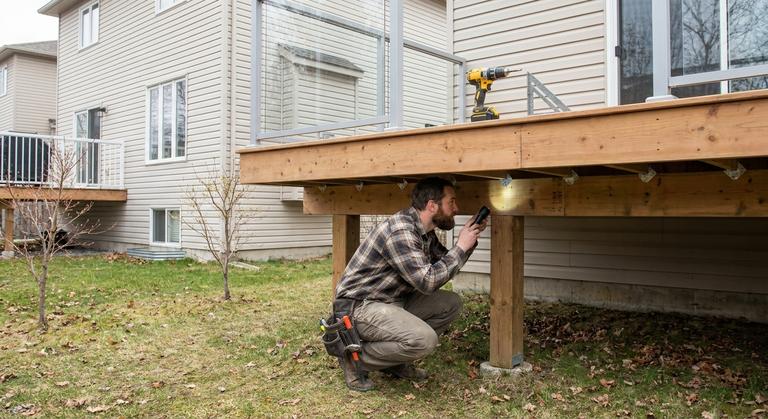
Every spring, once the frost lifts and tenants drag the patio furniture back outside, deck complaints arrive in a wave: spongy boards, a guard that wobbles when someone leans on it, a stair stringer gone soft at the base. Pinning down deck repair cost Canada-wide is harder than it looks, because the price depends far less on square footage than on what is happening underneath - the footings, the ledger connection, and whether the structure ever met code in the first place. This guide covers how to triage a failing deck, what actually moves the price, when a permit is required, and the guard and railing rules Canadian inspectors genuinely check on site.
Triage First: Repair, Rebuild, or Replace
Before you request a single quote, decide which of three jobs you are actually buying. Contractors price these very differently, and mixing them up is the fastest way to end up comparing bids that have nothing in common.
Surface work only
New decking, fasteners, and finish over a sound frame. This makes sense when the substructure has years of life left: posts dry and solid at the base, joists sound where they meet the ledger, footings not heaved. If you replace boards over a frame that fails two seasons later, you have paid twice.
Structural repair
Sistering rotted joist ends, replacing a stair stringer, rebuilding guard post connections, re-flashing and re-fastening the ledger. This is the most common category on rental stock built in the 1990s and 2000s, and it is where most of the deck repair cost in Canada actually sits.
Full rebuild
When footings are undersized or frost-heaved, when the stair layout no longer works, or when the whole structure predates the guard provisions now in force. A useful rule: once more than roughly a third of the substructure has to come out, ask for a rebuild price alongside the repair price. The gap is often narrower than managers expect, and a rebuild resets both your inspection clock and your liability position.
Deck Repair Cost Canada: What Actually Moves the Number
Deck repair cost Canada estimates vary enormously by province, city, and season, so treat any single figure you find online with suspicion. What stays consistent is the set of drivers. In rough order of impact:
- Height above grade. Once the walking surface sits more than 600 mm above the adjacent ground, guards come into play. Go significantly higher and you add taller guards, deeper footings, bracing, and sometimes an engineer's stamp.
- Footings and frost depth. Footings must bear below the local frost line, and that depth is set by your municipality - the Prairies require far deeper excavation than coastal British Columbia. Helical piles often win on tight sites or where excavation is impractical.
- Ledger and building envelope. If the ledger has to come off, you are into flashing, sheathing repair, and sometimes cladding work. This is the single most common source of scope creep on deck jobs.
- Material. Pressure-treated SPF is the budget baseline. Cedar, composite, PVC, and aluminum decking each carry a material premium in exchange for lower maintenance - a trade worth making on buildings where you cannot reliably schedule staining every few years.
- Guard system. Wood pickets are cheapest. Aluminum and glass systems cost more up front, but they survive tenant abuse and shed snow better.
- Access and disposal. Rear yards with no gate, third-storey walk-ups, and treated lumber disposal all add real hours.
- Season. Anything booked in April and May is priced against a full order book. Autumn work is often quieter and cheaper.
How to read a deck quote line by line
Ask every bidder to split the price into demolition and disposal, footings, framing, decking, guards and handrails, stairs, and permit or drawing costs. Broken out that way, the differences become obvious: one crew has priced surface blocks while another has priced frost-depth footings, or one has assumed the existing ledger stays put. Contractors who understand their own numbers can defend every line, and reading a little about how trades build their pricing - Construction Arbitrage is a solid primer on the business side - makes those conversations much faster.
Permits: When You Need One, and What It Costs in Time
Permits are municipal, and thresholds vary. The most common triggers across Canadian jurisdictions are a deck attached to the building, or a walking surface more than 600 mm above grade. Small freestanding ground-level platforms are frequently exempt. Confirm with your local building department before assuming anything, and remember that Ontario, Quebec, British Columbia, and Alberta each administer their own code adaptations.
The permit fee is rarely the problem. The schedule is. A typical application asks for:
- A site plan showing deck location, dimensions, and setbacks from property lines.
- Framing drawings with joist and beam sizes, spans, and footing details.
- Guard and stair details, including heights and opening sizes.
- For condominium or strata property, written board approval before the municipality will process anything.
- Staged inspections, usually footings before backfill and framing before the decking goes down.
Those staged inspections matter to your calendar more than the paperwork does. If the crew closes in a frame before the inspector attends, you may be paying to open it back up, which is a line item nobody quoted. Build the inspection windows into the schedule and state in the contract who books them.
Guard and Railing Code Rules Inspectors Actually Check
Provincial codes are based on the National Building Code of Canada with local amendments, so verify specifics against the code in force where the property sits. The recurring items on any inspector's list:
- Guards are required where the walking surface is more than 600 mm above the adjacent level.
- Guard height is commonly 900 mm for decks close to grade, rising to 1,070 mm for higher decks in residential buildings.
- Openings must not allow a 100 mm sphere to pass through, the standard test for keeping small children from slipping between members.
- Non-climbable zone: horizontal members and ledges that let a child climb the guard are a failure point, which is why fashionable horizontal-rail designs get rejected.
- Guard post connections must resist lateral load. The classic defect on older Canadian decks is a notched 4x4 lag-screwed to the rim joist. Current practice uses through-bolts with blocking, or proprietary tension hardware.
- Handrails on stairs must be graspable and set within the code height range. Short exterior flights serving a single dwelling are often exempt, but that exemption does not automatically carry over to multi-unit buildings.
- Fasteners in contact with treated lumber must be hot-dip galvanized or stainless. Standard zinc-plated screws corrode quickly in modern copper-based preservatives, and that failure is invisible until a board lifts.
If your portfolio includes decks built before the current guard provisions, you are generally not required to upgrade until you carry out structural work. Once you touch the guard, though, you are building to today's rules, and that reality belongs in your deck repair cost Canada budget line rather than in a surprise change order.
Buying the Work Without Getting Burned
Deck crews turn over constantly. The carpenter who built your last three decks may have sold the business or moved on entirely - trade businesses change hands far more often than most managers realize, as sites like Contractor Exit make plain. Do not build your seasonal programme around a single relationship.
Before awarding, ask for:
- A valid workers compensation clearance certificate for the province: WSIB in Ontario, WorkSafeBC, CNESST in Quebec.
- Proof of commercial general liability insurance naming the property.
- Written confirmation of who pulls the permit and who attends inspections.
- A workmanship warranty separate from the manufacturer warranty on the decking product.
Platforms like PlanaJob let property managers post the job once and compare quotes from vetted contractors side by side, which is the quickest way to tell whether the outlier price is a genuine bargain or a missing scope line. If you run multiple buildings, the property manager tools are built around exactly this kind of seasonal, multi-site work, and more regional cost guides sit on the PlanaJob blog.
When you are ready to price real work, PlanaJob carpenters quote code-compliant deck repairs and rebuilds with permit guidance included, so drawings and inspection stages are handled up front rather than discovered halfway through the build. Post your deck job and start comparing.
FAQ
Is repair always cheaper than a full deck rebuild?
Not always. Isolated defects such as one bad stringer or a handful of joist ends are clearly cheaper to repair. But once demolition, disposal, and mobilization are in the price, a large repair starts converging on rebuild territory, and the rebuild gives you new footings, current guard compliance, and a fresh warranty. Ask for both numbers on any job touching the substructure.
Do I need a permit just to replace deck boards?
Usually not, if you are replacing decking on an unchanged structure and touching nothing structural. Change the framing, the footings, the stairs, or the guard configuration and you are generally back into permit territory. Municipal rules differ, so a phone call to the building department is cheaper than a stop-work order.
How much of the deck repair cost in Canada is labour versus materials?
It swings with the scope. Structural repairs are labour-heavy because the diagnostic and demolition work is slow and the material list is short. Composite or aluminum resurfacing flips that, with the product dominating the invoice and installation relatively quick. Ask each bidder to show the split, because a quote that is unusually material-light often means the crew has not priced the substructure work you actually need.