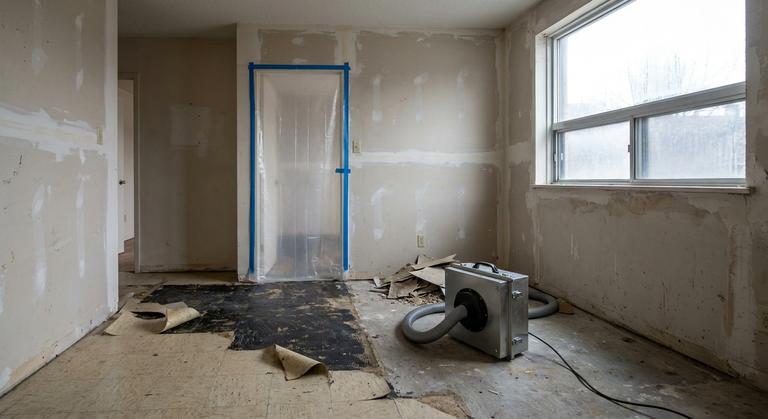
A 1974 walk-up needs a new bathroom. The tile comes off, the crew cuts through the wall board, and by the time anyone asks about testing, the dust has already travelled through the return air ducts into four other units. That sequence is the most expensive avoidable mistake in Canadian rental renovation. The asbestos renovation rules Canada applies to pre-1990 buildings are not triggered by the age of the building or the size of the budget. They are triggered the moment a worker is likely to disturb a material that might contain asbestos. The same logic governs lead. Knowing where that line sits, and who owns the duty on each side of it, is the difference between a two-week bathroom and a stop-work order with a tenant relocation attached.
What "pre-1990" actually means in a Canadian building
Canada banned the manufacture, import, sale and use of asbestos and asbestos-containing products in 2018, but that ban does not reach backwards into buildings already standing. Anything built or last renovated before roughly 1990 should be treated as suspect until a lab result says otherwise. Regulators in every province work from the same starting position: presume asbestos, or test.
Where asbestos hides in a 1960s to 1980s rental
- Vermiculite attic and wall-cavity insulation, particularly the loose grey-brown pellets sold as Zonolite. Health Canada's guidance is to assume vermiculite insulation contains asbestos and leave it undisturbed.
- Drywall joint compound and textured or stipple ceilings. This is the one that catches most renovations, because nobody thinks of taping mud as a hazardous material.
- Vinyl floor tile, sheet flooring backing, and the black mastic under both.
- Pipe and boiler insulation, duct wrap, and the tape at duct seams in older mechanical rooms.
- Cement board products: flue pipes, soffits, siding panels, electrical panel backing.
- Plaster, acoustic ceiling tile, roofing felt and window glazing putty.
Where lead shows up
Canada restricted lead in interior consumer paint in the 1970s and tightened the limit again in the mid-2000s under the Surface Coating Materials Regulations. In practice, units painted before 1960 carry the highest risk, and coatings applied through the 1970s and 1980s can still carry meaningful lead, especially on exterior surfaces, railings, window sashes, door frames and high-gloss enamel trim. Lead solder came out of potable water plumbing around 1990, so a pre-1990 building may also have lead at the service line or in the joints.
The renovation risk with lead is never the intact paint. It is sanding, heat-gun stripping, dry scraping and window replacement, all of which convert a stable coating into airborne dust in a unit where a family is about to live.
Asbestos renovation rules Canada applies: who owns the duty
Here is the part that surprises new property managers. There is no single federal renovation rule. Occupational health and safety is provincial, so the asbestos renovation rules Canada enforces are thirteen separate regimes, and the duty usually starts with the owner or the party who controls the building, not the contractor.
The common structure across all of them:
- Before work starts, a qualified person surveys the affected area and samples anything suspect, with analysis by an accredited lab.
- The results go to the contractor in writing, before they price the job.
- The work is classified by risk level, which dictates containment, respiratory protection, worker training, and whether the regulator must be notified.
- Waste is bagged, labelled and disposed of under provincial hazardous or designated waste rules.
- Clearance is confirmed before the space returns to use.
Skip step one and you have not simply created a health risk. You have usually breached a statutory duty in your own name.
Ontario
Under the Occupational Health and Safety Act, the owner of a project site must determine whether designated substances, including asbestos and lead, are present, and must provide that list to every prospective constructor and bidder before they submit a price. That designated substance report is an owner obligation. You cannot push it onto the winning contractor after the fact. Ontario Regulation 278/05 then sorts asbestos work into Type 1, Type 2 and Type 3, with Type 3 requiring ministry notification, full enclosure and negative air pressure. Owners of buildings with known asbestos-containing material also have to keep a record and inspect it on a schedule.
British Columbia
B.C. has the strictest regime in the country. Since January 2024, firms performing asbestos abatement must hold a WorkSafeBC licence, and workers and supervisors must complete approved certification training. A qualified person must survey for hazardous materials before demolition or renovation that could disturb them, and a Notice of Project goes to WorkSafeBC. Hiring an uncertified crew in B.C. is now a straightforward enforcement matter rather than a grey area.
Quebec
CNESST rules require building owners to locate asbestos-containing flocking and thermal insulation, record it in a register kept with the building, keep that register current, and pass the relevant information to anyone doing work that might disturb it. The register is not filing-cabinet paperwork. It is the first document an inspector asks to see.
Alberta, the Prairies and Atlantic Canada
Alberta's OHS Code sorts asbestos work into restricted, moderate and high-risk categories, with notification required for high-risk removal. Saskatchewan, Manitoba, the Atlantic provinces and the territories run comparable tiered systems under their own regulations. The classification labels differ. The survey-first principle does not.
The tenant side of the file
Compliance is not only occupational health and safety. You are working inside occupied housing.
- Serve proper written entry notice under your provincial residential tenancy legislation, commonly 24 hours in writing with the reason and time window stated.
- If the scope requires the unit to be empty, check what your province demands. Ontario requires a specific form, compensation and a right of first refusal. British Columbia now requires the landlord to apply to the Residential Tenancy Branch for approval before ending a tenancy for renovation, rather than simply serving notice.
- Notify the whole affected stack, not just the unit. Type 3 asbestos work in a building with shared ventilation usually means shutting down and sealing the HVAC serving that zone.
- Put everything in writing. "The contractor said it was fine" is not a record, and it is not a defence.
What to ask before you accept a quote
Bids on a pre-1990 building are not comparable unless every bidder receives the same hazardous materials information. Give them the survey, then ask:
- Which class or type of work does this scope fall into under our provincial regulation, and why?
- Show me the licence or certification. In B.C., the WorkSafeBC licence number. Elsewhere, worker training records matching the type of work quoted.
- Who is the qualified person or consultant, and are they independent of the abatement crew?
- Will you file the notice of project, and can I have a copy?
- How is the waste manifested, and where does it go?
- Who performs clearance air sampling, and does that report come to me directly?
- Does your liability policy actually respond to asbestos work? Many general liability policies carry a pollution or asbestos exclusion, and the certificate of insurance alone will not tell you.
A contractor who answers all seven without stalling has done this before. One who gets vague on item two or item seven is quoting a job they are not equipped to run. Platforms like PlanaJob let property managers compare quotes from vetted contractors side by side, which makes the gap between a properly scoped abatement bid and an optimistic general renovation bid obvious before anyone signs.
When you are explaining to an owner why the abatement number looks the way it does, the margin and risk-pricing breakdowns at Construction Arbitrage are a useful primer on how specialty trades load hazard work. It is also worth knowing that licensed abatement firms are thin on the ground outside major centres and tend to change hands as going concerns rather than being rebuilt from scratch, a market dynamic tracked over at Contractor Exit.
Records, waste and closing the file
The asbestos renovation rules Canada operates through put long-tail record-keeping on the owner, not the trade. Keep the survey report, the lab results, the notice of project, the waste manifests and the clearance air results together, filed against the building rather than the job. Two years later, when the next contractor asks what is behind that wall, the file answers in thirty seconds instead of forcing a fresh survey. For lead, keep the same discipline: testing results, the work method used, and confirmation that the unit was cleaned with HEPA equipment and wet methods before turnover.
Build the survey into your standard process
The practical fix is boring and it works. Add a hazardous materials survey to the front of every scope on a pre-1990 asset, before tender, not after award. Budget the lab turnaround into your schedule. Treat the survey as a building asset that gets updated, not a per-job expense you resent.
PlanaJob verifies contractor abatement certifications so you do not have to chase licence numbers and training records yourself. You can see how that works for Canadian portfolios on our property manager overview, create an account to post a scoped job to vetted trades, or browse more compliance guides on the PlanaJob blog.
Frequently asked questions
Do I need a survey for something small, like swapping a bathroom vanity?
If the work will not disturb building materials, no. If it involves cutting drywall, removing tile, lifting flooring or opening a wall in a pre-1990 unit, yes. Scope size is irrelevant under the asbestos renovation rules Canada applies through provincial OHS. Disturbance is the trigger, and a single afternoon of unprotected drywall sanding can contaminate a unit.
Is vermiculite insulation always asbestos?
Not always, but the safe operating assumption is yes. Much of the vermiculite installed in Canadian attics came from a mine with amphibole asbestos contamination, and you cannot tell by looking. Do not sample it yourself, do not vacuum it, and do not let electricians or insulation crews work in that attic until a qualified person has assessed it.
Who is liable if a contractor disturbs asbestos without telling me?
Both of you, usually. The contractor carries worker safety duties, but as owner or the person controlling the building you typically carry the duty to identify hazardous materials and disclose them before work is priced. Regulators routinely name the owner when no survey exists. That is exactly why the survey belongs at the front of your process rather than in the contractor's scope of work.