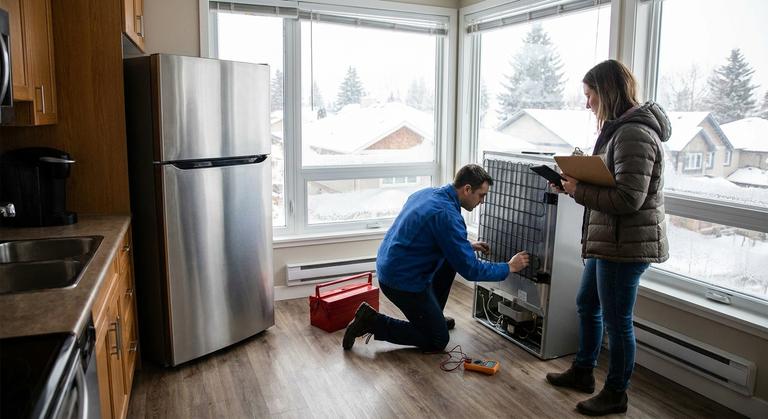
A tenant messages at 4:40 on a Friday to say the fridge is warm and the milk has turned. You have twenty minutes to decide whether to dispatch a tech, order a replacement, or do both and sort it out afterwards. Getting that judgement right, over and over, is the difference between a maintenance budget that holds and one that quietly bleeds. The uncomfortable truth is that appliance repair cost in Canada is rarely the deciding number on its own. What decides it is the repair quote set against the fully installed cost of a replacement, the age of the unit, who pays the utilities in that suite, and how the CRA treats the spend at year end.
What actually drives appliance repair cost in Canada
Most property managers read a service invoice as one number and file it. The appliance repair cost in Canada that lands on your desk is really five or six separate charges, and seeing them separately is what lets you negotiate.
The line items on a repair invoice
- Diagnostic or trip fee. Structure matters more than amount: flat or hourly, and is it credited against the repair if you approve the work?
- Labour. Hourly or flat-rate book time. Sealed-system and bearing jobs are labour heavy.
- Parts. The biggest swing. Compressors and proprietary boards sit at one end; gaskets, thermostats, igniters, pumps and belts at the other.
- The second visit. No van carries every part. Assume two trips for board or sealed-system work, and ask whether the return is billable.
- After-hours and access. Weekend and holiday rates are higher, and elevator bookings, loading docks and downtown parking are billable hours.
Replacement quotes hide their own extras: delivery, haul-away and recycling of the old unit, installation with a fresh hose set or transition duct, levelling, and sometimes trim work when a current model does not fit a 1990s opening. Compare installed cost to installed cost, never sticker price to invoice.
Four decision rules that beat gut feel
Once you know what you are being billed for, weighing appliance repair cost in Canada against replacement becomes a set of rules you can delegate.
- The 50 per cent rule. If the repair quote exceeds half the fully installed replacement cost, replace. It is blunt, defensible to an owner, and usually right.
- Age against expected service life. Ranges and fridges tend to last longest, dishwashers the shortest, laundry in between. Once a unit is past roughly two-thirds of the life you plan around, a major failure is a replacement.
- The second-failure rule. Two chargeable calls on the same unit inside twelve months means replace, whatever the third quote says. You are paying twice for diagnosis and once in tenant goodwill.
- Component severity. Sort by component, not by appliance. Some faults stay cheap forever, others are terminal.
Almost always worth repairing
Door gaskets and hinges, thermostats, thermistors and thermal fuses, oven elements and surface igniters, drain pumps, fill valves, drive belts, dryer rollers, fan motors and defrost heaters.
Usually means replace
Sealed-system faults (compressor, evaporator, refrigerant leak), front-load drum bearings and cracked tubs, main control boards on builder-grade units, oven cavity rust-through, and any fault at all on a unit past its expected life.
Repair or replace, appliance by appliance
Refrigerators
Everything outside the sealed system is repairable and usually inexpensive. Everything inside it is a replacement conversation, because the labour is high and the result on an older cabinet is uncertain. Refrigerant work must be done by a technician certified under the federal and provincial rules governing halocarbons, so it is never a superintendent job. Treat a warm fridge as same-day work: provincial tenancy legislation generally makes you responsible for appliances supplied with the tenancy.
Washers and dryers
Dryers are the best repair value in the building. Fuses, belts, rollers and thermostats are cheap and fast, and a restricted vent is a common cause behind a no-heat complaint, so check the vent before authorizing any part. Front-load washers are the opposite: once you are into drum bearings or a cracked tub, labour alone clears the 50 per cent line. Gas connections are licensed gas fitter work, overseen by the TSSA in Ontario and equivalent authorities elsewhere.
Dishwashers
Dishwashers have the shortest realistic service life, and the labour to pull, disconnect and re-plumb one is nearly identical whether you repair or replace. That asymmetry pushes borderline calls toward replacement, and hard water across much of the Prairies and parts of southern Ontario pushes them further. Fill valves, drain pumps and door latches are worth fixing; a failed board or leaking tub is not.
Ranges and ovens
Elements, igniters, thermostats, hinges and door glass are straightforward repairs at almost any age. Rust-through or a failed board on a builder-grade range is a replacement. Before ordering, confirm the existing circuit, receptacle and gas connection match what the new unit needs, because older suites surprise people and any electrical alteration is licensed electrician work.
The Canadian variables that change the math
Who pays the hydro and the water
If the tenant holds their own hydro account, an efficiency upgrade never comes back to you, so judge the swap on reliability alone. In a bulk-metered walk-up where you pay heat, hydro and water, an ageing top-load washer or a 1990s fridge is a standing operating cost, and an ENERGY STAR certified replacement can pay for itself over the hold period. Utility and provincial rebates change constantly, so confirm eligibility first.
How the CRA sees the two options
A repair is generally a current expense, deductible in the year you incur it. A replacement is generally a capital expense, added to a capital cost allowance class (appliances usually land in Class 8) and written down over years. Identical dollar amounts hit the same return very differently, which is why a marginal call in December is not the same decision as in March. Confirm the treatment with your accountant.
Parts, brands and vendor continuity
Standardizing on one or two model families per building makes parts predictable and techs faster. Premium imported brands photograph well in a listing and quietly cost you in parts lead times. Keep two vendors on file, too: appliance service businesses change hands more often than owners expect, and the mechanics of those sales are covered at contractorexit.com. Never start a vendor search during a July heat wave.
Build a cost baseline instead of pricing every job cold
- Log every call: suite, appliance, brand, model, install year, symptom, fee, parts, labour, outcome.
- Calculate your own median spend by appliance type and by city. That local median is the appliance repair cost in Canada that applies to your portfolio, not a national average.
- Write the approval threshold into policy so coordinators can green-light small repairs.
- Pre-negotiate a flat diagnostic fee and a rate card with both vendors, renewed each year.
- Fund a per-suite replacement reserve so a bad quarter does not become a capital request. Treating maintenance as a planned capital cycle rather than a run of emergencies is a habit worth reading up on at constructionarbitrage.com.
- Photograph the model and serial plate at every turnover inspection. A surprising share of diagnostic delays trace back to a missing model number.
- Schedule replacements at turnover wherever timing allows; a bridging repair six weeks from vacancy is a strategy, not a compromise.
How to brief a contractor so the quotes are comparable
Ask every vendor for the same five things: the diagnostic fee and whether it is credited, a parts list with part numbers, estimated labour hours, the warranty on parts and labour, and a realistic lead time. Without those, you are comparing prices for different jobs. Platforms like PlanaJob let property managers post the job once and compare quotes from vetted contractors side by side instead of chasing three callbacks, and you can see how the Canadian side works on the property managers page.
When a call is genuinely borderline, what you need is not another price. PlanaJob techs attend on a flat diagnostic fee and give a straight repair-or-replace verdict with the reasoning attached, so you can send the owner one honest recommendation instead of three quotes and a shrug. You can open an account in minutes or read more cost guides on the PlanaJob blog.
FAQ
Is it worth repairing a ten-year-old fridge?
If the fault sits outside the sealed system, usually yes: those parts are cheap and the visit is short. If it is the compressor or a refrigerant leak, no. Apply the 50 per cent rule against fully installed replacement cost, and check whether the suite turns over soon.
Who pays for appliance repairs in a Canadian rental?
Where the appliance was supplied with the tenancy, provincial residential tenancy legislation generally puts maintenance on the landlord, and tenant-owned appliances stay with the tenant. If the damage came from negligence you may be able to recover through the provincial tribunal, but the repair still has to happen first. Rules vary, so work from your own province's act.
How long should an appliance repair be warrantied?
Ask before approving the work and get it written on the invoice: coverage on the part, coverage on the labour, and the term for each. A vendor who will not stand behind their own labour is telling you something useful, and it should shape how much appliance repair cost in Canada you approve on an ageing unit.